Technology Standards That Remodeling Franchise Systems Mandate
Home services ranks among the fastest-growing franchise categories tracked by an industry trade association, and remodeling franchises are grabbing a bigger slice of that market for a reason that has nothing to do with craftsmanship. The advantage is structural. Franchise agreements legally require technology standards that most independent contractors never adopt on their own, and the gap between the two groups is widening every quarter. What follows breaks down what those mandates actually require, so an independent operator can build the same operating system without paying a franchise fee for the privilege.
American housing stock keeps aging, and homeowners are choosing to fix up what they own instead of moving. Residential and commercial services are projected to grow at roughly 3.2% year-over-year in 2026, ranking among the top growth categories in franchising alongside child services. That demand will keep growing. Who captures that demand is the real issue, and franchise systems are winning a bigger share not because their crews swing a better hammer, but because every touchpoint before and after the job runs on a standard timed down to the minute.
How franchise agreements turn technology into a legal obligation
Franchise agreements typically carry what attorneys call "then-current standards" language. Franchise attorney Luther Lanard PC, reviewing actual agreement text, found provisions requiring franchisees to add to, improve, modify, and remodel their equipment, fixtures, and facilities to match whatever standard the franchisor sets at any given moment. Not the standard at signing. Whatever standard applies later, whenever later happens to be.
One clause from Lanard's review makes the open-endedness plain: "You are obligated to comply with all modifications to system standards, including a capital modification, within the time period we specify." No cost ceiling. No advance notice requirement. No cap on what "capital modification" might turn out to mean.
Better-drafted agreements build in guardrails: written notice minimums, timelines that stretch out for anything above a set dollar threshold, and negotiated caps on total cost. These details matter less as legal trivia and more as a signal, since they show what franchisors themselves treat as the floor, the minimum tech spend they're willing to put in writing and enforce.
The FTC's staff guidance from July 2024 flagged a related pattern: franchisors rolling out new fees, including technology and payment processing fees, through operations manual updates instead of disclosing them in the Franchise Disclosure Document. The National Law Review's 2025 recap of that guidance noted the FTC called these undisclosed fees illegal, though the agency's own wording was hedged, describing them as something that "may be an unfair act or practice." The categories the FTC named are the tell: mandatory software platforms, point-of-sale systems, vendor programs that kick rebates back to the franchisor, and marketing fund expansions, all introduced through the back door of an operations manual rather than a contract. That's exactly where franchisors invest hardest, because the legal friction occurs there, in the operations manual changes to systems, vendor programs, and marketing fund expansions rather than in the contract. CRM, quoting, lead management, communication systems. Franchise systems are also consolidating toward single platforms instead of a pile of disconnected tools, using providers like FranConnect for lifecycle management, Salesforce for a unified customer view, and Rallio for social and digital presence. That consolidation is a mandate, not a suggestion, and any franchisee who tries to run a side tool outside it usually finds out the hard way.
The specific technology layers franchise remodeling systems require
Window World has been ranked America's number one exterior remodeling franchise by Qualified Remodeler every year since 2011, and it now runs over 225 locally owned retail locations, all on the same proprietary CRM: WW360. Lead capture, scheduling, and automated customer follow-up all run through it. No unit opts out. Every lead moves through one system from first contact to close, which wipes out the spreadsheet-and-sticky-note approach still running most independent shops.
DreamMaker Bath & Kitchen took a different angle on the same problem. Its platform supports expansion from single-room remodels into full interior work, built specifically to stretch marketing dollars further and turn one-time customers into repeat ones. That's a lifecycle-revenue strategy baked into the system architecture from day one, not bolted on after the fact.
Speed-to-lead is where the mandates get most specific. Franchise systems don't hand a franchisee a CRM and call it done. They set a response-time standard, and missing it carries real consequences within the franchise system, not just an informal coaching conversation. Communication standards extend to channel too: systems now build for text and chat alongside phone, because most homeowners prefer text or chat over a phone call when given the choice.
Cybersecurity is the newest mandate category. Ignite Visibility's 2026 franchise trends analysis found major systems pushing standardized cybersecurity protocols across every unit, treating data protection as a system-wide requirement rather than a unit-by-unit choice. The same analysis tracks AI phone agents, automated review requests, and cloud-based workflows moving out of pilot programs and into broader adoption across leading systems.
Look at the pattern running through all of it. Each layer takes a decision away from the franchisee, or their staff, that used to require a judgment call. That's the whole point. The mandate isn't a technology requirement so much as a forcing function, one that keeps hundreds of units from drifting off in a hundred different directions.
What the speed-to-lead mandate produces in revenue terms
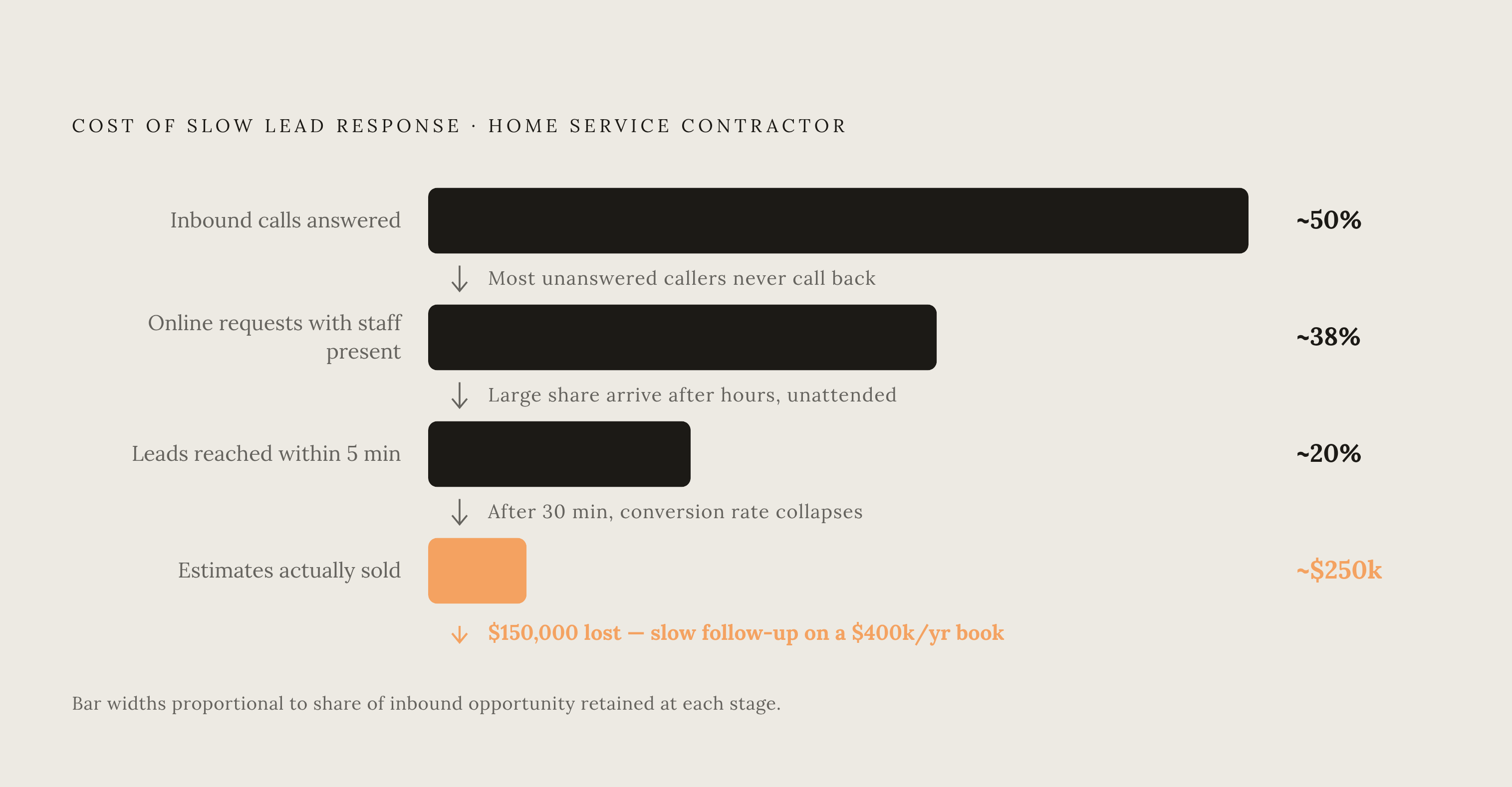
Start with the raw number. Roughly half or more of inbound calls to small home-service businesses go unanswered, and most of those callers never call back. That's half the top of the funnel gone before a quote ever gets built, and it happens quietly enough that most owners never notice the leak.
Housecall Pro's booking data adds another layer: a big share of online bookings land after hours, when most shops have nobody at the desk. Franchise systems build AI and automation specifically to plug that window, because a lead sitting unanswered at 9pm on a Tuesday is a lead a competitor with a chatbot picks up instead.
The math behind the urgency is well-documented in lead-response research: a lead contacted within five minutes converts at a far higher rate than one reached after thirty minutes. Franchise lead-response protocols are built around that single figure, five minutes as the design spec, not the aspiration.
CI Web Group's research backs up what happens once the automation runs. Businesses using AI chatbots for lead response see conversion rates climb 30% to 50%, with response times cut roughly in half compared to a standard web form. AI-enhanced CRM systems, the same research found, push lead response rates up 42%. That's the exact category Window World's WW360 and comparable franchise platforms are built to require.
A contractor without this infrastructure isn't just working slower. Every lead that comes through the door converts at a structurally lower rate, whether the owner notices or not. A 365 Lead Strategy internal case study puts a number on the damage: a contractor earning roughly $400,000 a year lost approximately $150,000 in unsold estimates, purely from weak follow-up. Not bad craftsmanship. Not bad pricing. Leads that went cold because nobody called back in time.
Franchise AI mandates reshaping quoting, marketing, and recruiting
Franchise-grade quoting tools now read job photos, project descriptions, location, materials, and labor effort, and spit out a quote in as little as 60 seconds. That kills the bottleneck most independents live with, where every estimate has to pass through the owner's calendar before a homeowner ever sees a number.
Marketing shows the same pattern. CI Web Group research found AI-driven email sequences post a 41% higher open rate than standard campaigns, and personalized sequences drive 70% more conversions than generic blasts. CI Web Group's research also found predictive audience targeting improves lead quality by 35%. Franchise systems, sitting on centralized data across hundreds of units, can deploy that targeting at a scale no single independent shop can match on its own, even though the underlying tools are available to anyone willing to buy them.
Recruiting has quietly become an AI category too. Franchise systems now run chatbots that pre-screen franchisee and employee candidates around the clock, so the humans on the hiring or sales team spend time only on people who already qualify. Labor is usually the ceiling on growth, and clearing that bottleneck is a major structural unlock. It's what lets a business scale instead of stall out at its current size.
Localized AI ties it together. The same national infrastructure produces market-specific campaigns for each unit, so a franchisee in one mid-sized city and one in another both get campaigns tuned to local demand. Add it up, and a new franchisee inherits a stack where quoting, follow-up, marketing, and hiring are already partly automated on day one. An independent chasing the same result has to build it piece by piece, on purpose, with nobody handing over a blueprint.
Franchise mandates and where independents are most exposed
The real gap is protocol. It's protocol. Franchise systems mandate specific behaviors: response windows, follow-up sequences, required communication channels. Most independents already own some of the same software, a CRM here, a texting app there, but nobody enforces when it gets used or how fast.
That points at a familiar bottleneck. Most home-service businesses stall somewhere between one and five million dollars in revenue, and it's almost always the same root cause: the owner is still the one making decisions a system should handle automatically. Every quote, every follow-up call, every after-hours lead routes back to one person's attention span, and that person only has so many hours in a day.
Fragmentation compounds it. Independents typically run separate tools for scheduling, quoting, follow-up, and marketing, none of them talking to each other. Franchise mandates for a single unified platform, lead to signed contract in one system, exist precisely because fragmentation is where revenue disappears between the cracks, quietly and a little at a time.
After-hours coverage is maybe the starkest gap. Franchise AI phone agents and chatbots close that window automatically. Most independents leave it wide open on purpose, or by neglect, which amounts to the same thing on the P&L. Industry surveys indicate roughly half of blue-collar business owners are already using AI day to day, with another large group planning to adopt within the year. A real share, though, have no plans at all, and that group is what keeps the gap between franchise-standard operations and the independent average from closing. If anything, it's widening.
The independents most exposed share a market and a customer base with an active franchise brand, particularly in the backyard-upgrade and legacy-home-renovation segments where franchise remodelers are pushing hardest right now.
Building the equivalent operating system as an independent
Start with the protocol, not the software. Before buying anything, decide what happens when a lead is received at 10pm on a Saturday. Franchise systems already have that answer built in and running automatically. An independent has to write the answer down first, then go find the tool that carries it out.
Layer one is a unified CRM covering everything from lead capture through signed contract. This is the non-negotiable foundation franchise systems mandate before anything else, because it kills the spreadsheet-and-email patchwork where leads quietly vanish between stages.
Layer two is automated lead response and follow-up. An AI agent handles first contact, asks qualifying questions, and books the appointment without the owner lifting a finger. That's the direct independent equivalent of the phone-agent and chatbot mandates franchise brands already run.
Layer three is quoting automation, taking estimating off the owner's personal calendar. AI-assisted quoting that reads job details and produces a real number fast enough that the homeowner is still sitting there, still in decision mode, closes deals that would otherwise go cold waiting on a callback.
Layer four is marketing automation with local targeting built in: AI-driven email sequences, audience targeting, automated review requests. These are the same capabilities franchise systems write into their marketing mandates, and they're available now through unified platforms built for independent operators, not exclusive to anyone with a franchise fee to spend.
Hardscape Mag runs on a free software stack built around this exact gap: AI Agents covering marketing, sales, leads, quoting, and operations, built so independent contractors can run at franchise-grade standards without paying a franchise fee, without a mandatory vendor program, and without the "then-current standards" clause that keeps franchisees perpetually on the hook for whatever comes next.
The all-in-one argument franchise systems make with their platform mandates holds up, and independents should take the hint rather than fight it. Building one integrated stack instead of stitching together a sprawl of separate apps kills both the operational fragmentation and the headache of keeping a dozen logins straight. Franchise systems onboard new units with the technology already configured and running from day one, and the independent version should look the same: live in hours, not buried in a months-long rollout.
Once lead response, quoting, and follow-up run without the owner standing in the loop, the owner's time shifts to where it actually counts: sales conversations, crew management, deciding which jobs are worth taking and which aren't. That's the same shift that lets franchise operators scale past the plateau instead of standing there as the ceiling on their own business.