Owner-Independent Sales Processes for Remodeling Companies
Documenting your sales process is the only way to build a business that doesn't depend on you.

NAHB's remodeling sales framework puts the share of firms where the business owner handles all selling at roughly 85%, with no defined sales system or processes behind it. That number describes a structural ceiling, not a staffing preference. When the owner is the entire sales function, the business can only grow as fast as one person can sit across the table from homeowners, close the deal, and then go run the job. Growth stalls at the limit of personal bandwidth, and value stalls right alongside it. A remodeling company that depends on its owner to generate every dollar of revenue is just a job with a payroll attached, not a business in the sense a buyer means the word. Anyone evaluating that company for purchase has to ask what happens to the pipeline the day the owner stops showing up, and the honest answer, in most of these shops, is that the pipeline disappears with him. Building a company that can be sold at full value means building a sales engine that runs independent of any one person's calendar, memory, or charisma, and that engine starts with documenting the process the owner currently carries around in his head.
Stages of a Repeatable Remodeling Sales Process
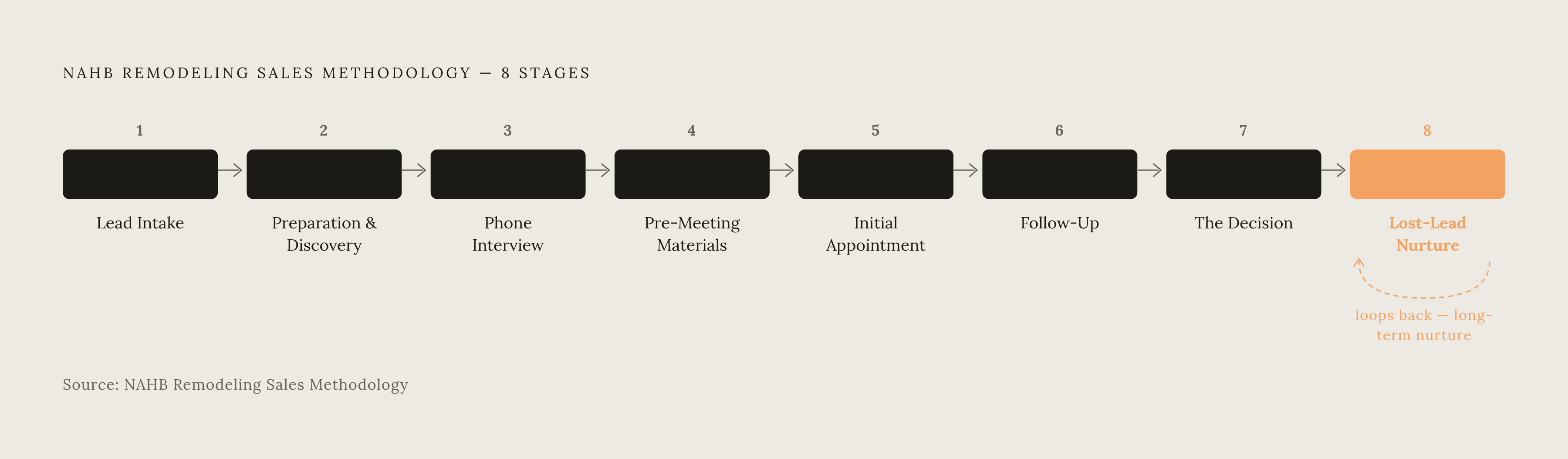
A sales process worth the name is a documented sequence of steps, each with a defined input, a defined output, and a clear handoff to the next step, built so that any capable person can run it the same way twice. NAHB's remodeling sales methodology lays out that sequence explicitly: lead intake, lead preparation and background discovery, phone interview and qualification, pre-meeting materials, the initial appointment, follow-up, the decision, and a lost-lead follow-up program. Each of those is a discrete stage with its own job to do.
Intake starts with a tracking form that captures date, name, address, phone, referral name, referral sources, whether a referral thank-you was sent, and whether the salesperson was notified. That form creates a paper trail that holds up even when the owner is on a job site and has no idea a new lead came in an hour ago. Lead preparation follows, and it's work any trained person can do without tapping the owner's personal network: pulling appraisal district data, looking at the home and neighborhood on Google Maps, checking social media, getting a sense of the homeowner's professional background. The phone interview has its own structure too: set the call length up front, fill out a qualification form, ask permission before digging into personal questions, and establish project scope and investment range before the conversation ends. Every one of these stages closes with a defined next step, whether that's a sale, a scheduled appointment, a decision timeline, or enrollment in the lost-lead program. Nothing is left open-ended, and nothing depends on someone remembering to follow up out of habit.
How lead qualification filters out time-wasters before the owner ever shows up
Qualification is where the owner's time gets burned fastest, and it happens before anyone realizes it's happening. An appointment with a lead who was never going to buy costs the same two hours as an appointment with a lead who was ready to sign, and the owner doesn't find out which kind of appointment he just drove to until he's sitting in the homeowner's living room.
Deal breakers need to get flagged before that appointment ever gets scheduled, not during it. Does the homeowner plan to sell the house? Is this a firm project or a vague idea someone is still kicking around? Is the homeowner collecting three or four bids with no real intention of hiring anyone, just pricing out curiosity? Those questions have answers, and the answers are knowable in advance. A website intake form that collects project type, location, timeline, and scope lets a sales rep triage every lead before the phone even rings. The owner's calendar then only fills up with appointments worth his time.
The objection owners raise here is predictable: they don't want to turn away a lead that might turn into money. An unqualified lead is an hours expense with no expected return, and that cost stays invisible precisely because most owners never track their own time against close rate by lead source. Once that tracking exists, the math on chasing every inbound call stops looking like generosity and starts looking like waste.
Speed of Response as a Structural Part of the Sales Process
Contractors who respond to a new lead within five minutes qualify it at a dramatically higher rate than contractors who wait even a short while longer, and that gap widens the longer the delay stretches. This is an order-of-magnitude difference between a firm that answers immediately and one that gets back to the homeowner an hour later.
Most remodeling firms miss that five-minute window constantly, and the reason is structural rather than a failure of effort. The owner is on a job site. He's on another call. He's standing in a supply yard with his phone in his truck. The exact activities that generate revenue, running production, managing crews, inspecting work, are the same activities that make him unavailable the moment a new lead comes in. A solo-selling owner cannot simultaneously manage a remodel in progress and answer every inbound call in real time, so the majority of those calls go unanswered, and most of those leads call the next name on their list.
That makes response speed a question of system design, not personal discipline. Who or what answers when the owner is unavailable? What does that first response say? What does it hand off to a human, and when? That sequence can be written down, trained, and automated, which turns a problem that used to depend on the owner's physical availability into a problem that gets solved by infrastructure instead.
The AI infrastructure layer that makes a sales process run without the owner in the room
AI tools function as the infrastructure that makes a documented sales process executable by anyone, at any hour, without the owner standing in the room to run it. AI receptionists handle inbound calls and web inquiries the moment no human is free to pick up, capturing lead information and triggering the same intake sequence NAHB's framework defines, now running on its own at two in the afternoon or eleven at night.
Platforms like GoHighLevel bring scheduling, email follow-up, review requests, and pipeline tracking together in one system. That matters because the alternative, a stack of ten separate apps with an agency managing each piece, is fragile by design. A system like that breaks the moment one vendor underperforms or one integration fails, and nobody notices until a lead has already gone cold. An owner-independent sales process needs infrastructure that holds together without someone checking on it every day, and a unified platform is built to do exactly that instead of depending on the owner to notice when a piece of the stack stops talking to the others.
AI coaching tools extend that same logic to the sales team itself. Tools that transcribe sales calls, track close rates by rep, and flag recurring objection patterns take over the job the owner used to do as informal sales trainer, debriefing a rep only on the days he had time for it. With the system generating that feedback automatically, every rep gets consistent coaching whether or not the owner is available that week, and the quality of training stops depending on the owner's schedule.
The Initial Appointment as a Trained Process Rather Than an Owner Performance
Owners resist systematizing the initial appointment more than any other stage, because they believe their personal rapport is the reason they win the job. The behaviors that make a first meeting effective are teachable. NAHB's meeting framework names them specifically: arrive on time, dress to project equal stature with the homeowner, review the lead's information before walking in, prepare qualifying questions along with likely answers, control the interview politely, talk only 10 to 20 percent of the time, and read body language, tonality, and mirroring. None of that requires being the owner. It requires training.
The meeting itself follows a defined agenda. Set the contract for the meeting at the start, meaning both sides agree on what a successful outcome looks like before the conversation goes anywhere. Cover the homeowner's questions and the rep's. Discuss money using "investment range" language rather than a bare number. Identify the personal reason behind the project, since remodels are rarely just about the house. And leave with something concrete every time, a sale, a scheduled next step, a decision timeline, or a specific piece of information to bring back.
Budget is the part of the meeting most untrained reps dodge entirely, because a direct question about money puts the homeowner on the defensive. NAHB's framework handles this with a third-party story instead, a way of normalizing the budget conversation by talking about what other homeowners in similar situations have spent, rather than demanding a number up front. Trust is the other obstacle standing between a good meeting and a signed contract, and a meaningful share of homeowners walk away from remodeling projects specifically because they don't trust the process or the contractor in front of them. A presentation book, a reference list, and pre-meeting materials sent ahead of time do that trust-building work before the rep ever knocks on the door. The first meeting then starts from a position of credibility instead of having to build it from zero in real time.
Handling Stalled Prospects Without the Owner Chasing Every Deal Personally
Most remodeling leads that go quiet after the estimate don't go quiet because the homeowner decided no. They go quiet because nobody followed up consistently enough to get a real answer, and in an owner-run shop, that usually means the owner got busy and the lead slipped.
When a homeowner stops responding, the documented process calls for a direct question rather than another polite check-in: "Do you want to continue with this project?" and "Are you still considering our firm?" Direct questions like these close the loop. They end the ambiguity that otherwise eats up weeks of follow-up cycles chasing someone who already decided against the project three weeks ago but never said so.
A useful tool for creating urgency without pressure tactics: reminding the homeowner that meeting their own stated deadline requires placing material orders now. That statement works because it's true, and a trained rep can deliver it with the same confidence an owner would, since it doesn't depend on personal rapport to land.
Automated follow-up sequences, email and SMS triggered by pipeline stage, carry the first several touchpoints without any person involved. The system only escalates to a human once the prospect responds or once a defined number of attempts has gone unanswered. None of this is spam. It's the systematic version of what a good owner already does by instinct, running on a schedule instead of on memory.
Lost leads get their own formal stage in NAHB's framework rather than getting abandoned after a no. A homeowner who turned the company down six months ago may be ready today if their circumstances changed, a new job, a sold house, a tax refund, and a documented lost-lead program tracks that possibility without relying on the owner to remember who said no and when.
Sales rep compensation structures that attract and retain closers worth replacing the owner
None of the process documentation matters if there's no one competent to run it. A trained sales rep who can execute the qualification, appointment, and follow-up stages reliably is the single asset that lets an owner step back from closing, and keeping that rep requires compensation built around the outcomes that matter to the business, not just activity.
Commission tied to closed revenue keeps a rep's incentives lined up with the owner's: both sides want the deal signed. Bonus structures tied to pipeline velocity, how quickly a lead moves from intake to decision, reward the discipline that keeps deals from stalling in the ambiguity the follow-up stage is built to eliminate. Tiered commission rates that increase once a rep clears a revenue threshold give a top performer a reason to stay past the first year instead of shopping competitors for a marginally better base rate.
A compensation plan built on these principles turns a sales role into a career a skilled closer wants to stay in, which is the final piece an owner-independent sales process needs to actually hold together over time.