Lead Management Systems Inside Multi-Location Remodeling Operators
Unified lead systems prevent scattered offices from losing jobs independently across your locations.
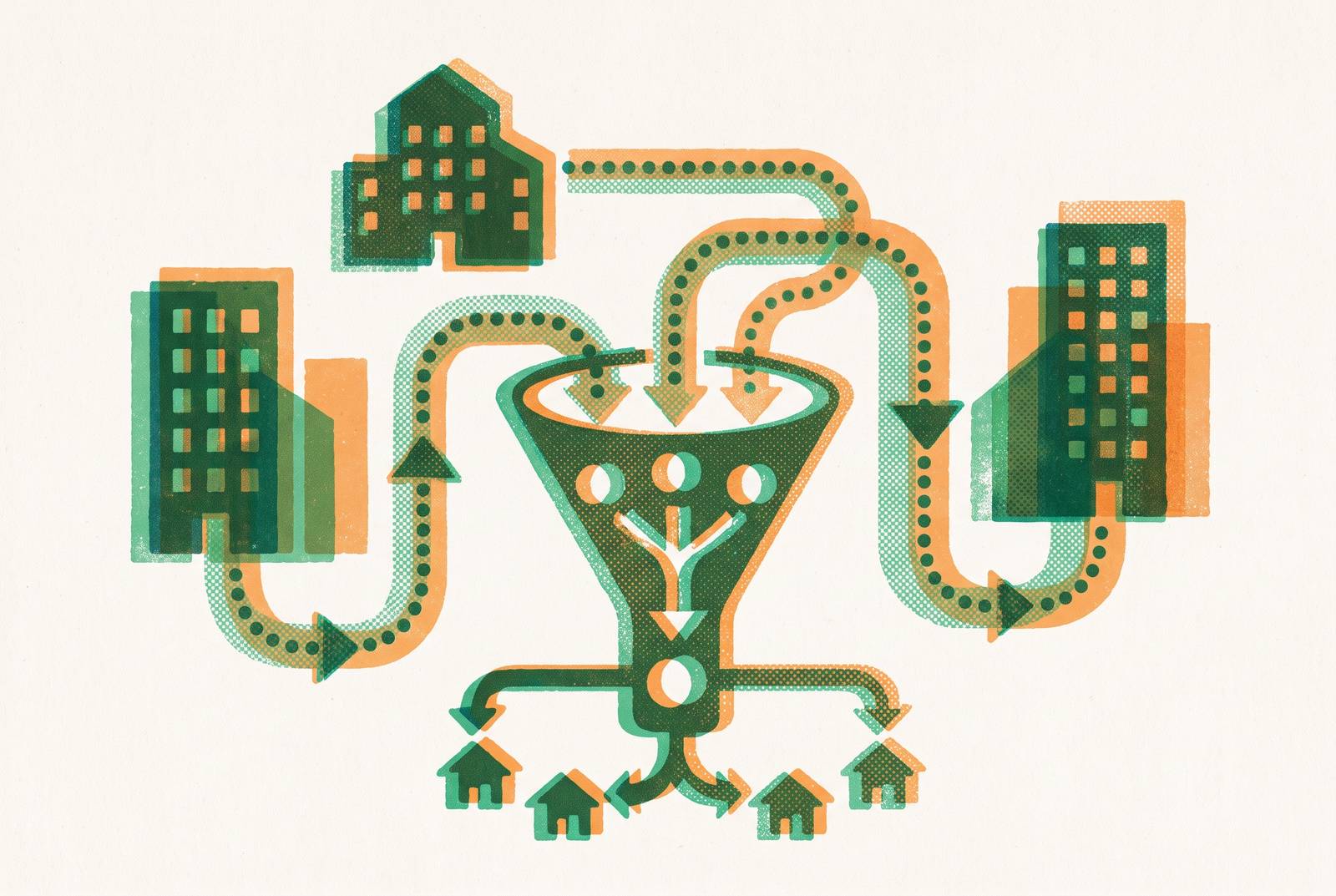
Multi-location remodeling operators run into a lead management problem that single-shop owners never see. It isn't a matter of scale: it's a matter of structure. Each office generates, handles, and loses leads on its own, while the person running the company needs one clear view across all of them at the same time.
A single-location shop keeps lead flow under control with a shared inbox, one sales rep, and an owner who notices when something slips. Friction is visible fast, and gets fixed fast, because the owner is standing right next to the problem. A multi-location operator doesn't get that. An inquiry that falls through at a satellite office can disappear completely, with nobody at headquarters ever learning it existed.
Each location starts to behave like its own small business. One office follows up within the hour; another lets quotes sit for a week. One has a tight phone script; another lets calls roll to voicemail after 5 p.m. The brand, the services, and the pricing are identical across every location, but the outcomes aren't, because the habits behind the scenes aren't.
That inconsistency compounds. A cold lead at one office doesn't just cost that one job. It costs brand trust, especially when a homeowner contacts two offices of the same company and gets two different experiences. That kind of mismatch is hard to recover from: the homeowner isn't comparing two contractors, but two arms of the same business, drawing conclusions about the whole operation from the gap.
Where leads fall through in a distributed remodeling operation
The losses that hurt most in a multi-location remodeling business happen at predictable points, the same handoffs where a hands-on single-location owner would catch the problem in real time. Nobody's watching those handoffs at all in a distributed structure.
Speed to first response is the first failure point. Average contractor response time runs to many hours, and homeowners doing their research through AI tools are already narrowing down their shortlist before a phone call even happens. A slow response from one office doesn't just delay the conversation. It ends the conversation before it starts, because the homeowner has moved to the next name on the list.
Missed calls and after-hours inquiries are the second failure point. Contractors and home-service businesses miss a large share of incoming calls as a matter of course, and every location's after-hours window turns into a dead zone. Leads call in at 7 p.m., get no answer, and quietly expire without anyone at the company knowing a call ever came in.
Inconsistent follow-up on outstanding quotes is the third failure point. One office sends a quote and never circles back, invisible to the operator unless someone happens to ask about it, and at five, ten, or twenty locations, this same gap repeats itself over and over, each time costing a job that was already most of the way to closed.
The absence of a shared pipeline view is the fourth failure point. When each office keeps its own spreadsheet or its own informal system for tracking leads, the operator has no way to see which markets are converting, which are leaking leads, or where in the process a given lead last got touched. Every one of these four points is a handoff: from inbound channel to office, from office to rep, from rep to quote, from quote to follow-up. In a distributed structure, each handoff is a spot where the operator has no visibility and no way to enforce a standard.
What centralized lead infrastructure means across locations
Centralizing lead management means every lead, no matter which office it contacts, enters the same pipeline, triggers the same response logic, and becomes visible on the same report, rather than routing every inquiry through one person at headquarters.
Three layers make up that infrastructure. The capture layer collects every inquiry, web forms, inbound calls, chat, paid lead platforms, and routes all of it into a single system no matter which market or channel it came from. The engagement layer runs the workflows, automated and human, that respond to, qualify, and move leads forward; this is where speed-to-lead rules, follow-up sequences, and qualification criteria actually live. The visibility layer is the reporting and the dashboards that let an operator check lead volume, response time, quote status, and conversion rate by location, without picking up the phone and calling each office.
The design principle holding all three together is straightforward. Each location keeps running its own sales conversations and its own estimates. The system enforces consistent behavior at every stage around those conversations, so a location can't opt out of the follow-up sequence or ignore the response time standard without the operator seeing that gap in the pipeline.
Service Experts, an established brand running dozens of locations (most of them corporate-owned), built this principle into its shift toward a franchise model: local operators run independently, but inside a shared system of technology, training, and operational support. The system doesn't take away local autonomy. It makes any deviation from standard visible. Home Based Franchise Group did something similar by standardizing workflows and putting Jobber, its shared franchise operations platform, in front of every franchisee. The company doubled its location count without losing the consistent customer experience its brands were built on, which shows that the infrastructure layer, not headcount, is what actually lets a remodeling business scale.
The system categories that handle each layer of the infrastructure
The tools that make this work divide cleanly along the three layers above. Operators who try to force capture, engagement, and visibility into one off-the-shelf tool tend to end up with gaps exactly at the handoffs between layers, the same handoffs that already cause trouble in a distributed structure.
On the capture side, platforms like GoHighLevel act as the front-end CRM for multi-location service businesses. Every inbound inquiry, whether it comes from the web, an ad, or a missed call, lands in a visual pipeline and triggers an automated follow-up sequence without anyone having to remember to send it. That gives every location the same starting point for every lead, regardless of which office picked it up. At the most basic level, missed call text-back is close to a minimum requirement for every location: when a call goes unanswered, an automated text goes out within seconds, which keeps the lead alive without needing a human to be sitting by the phone.
The engagement layer handles speed, qualification, and follow-up. An AI receptionist that answers every inbound call and web lead in under 60 seconds, qualifies the job type and timeline, and books the estimate removes the roughly 42-hour average response gap from every location at once, not just the ones with sharp office managers. Automated bid follow-up ranks among the highest-return automations available to contractors: a system that checks in on outstanding quotes on a set schedule recovers jobs that would otherwise go cold simply because no rep remembered to call back. On the estimating side, Handoff AI generates detailed estimates from photos, drawings, or project descriptions and turns them into client-ready proposals, cutting the quote turnaround window sharply so an estimate goes out before a slower competitor's even finished.
The visibility layer is where the operator checks the health of the whole system. ServiceTitan fits well where individual locations run with dedicated office staff and a sizable technician base, providing the scheduling, dispatch, and job-level reporting that makes per-location performance visible without a site visit. HubSpot's conversation intelligence tools record and analyze sales calls across locations, surfacing which talk tracks close deals and where coaching is needed, giving the operator a standard way to judge how each location sells, not just how many leads it happens to close.
Enforcing consistent lead handling across independent locations
Installing these systems is the easy part. Operators who stop there, assuming the technology alone will hold the line, find that each location drifts back to its old habits within a matter of weeks. Enforcement has to be built into how the system works, not left to each office's discipline.
The core enforcement mechanism is pipeline visibility. When an operator can see, location by location, which leads sit in which stage and how long they've been there, a deviation from the standard response time or follow-up cadence is visible in that view on its own. Nobody at the location has to report it, and nobody at headquarters has to go digging for it.
Automated sequences close off the biggest category of deviation. If the follow-up runs on its own, a text within minutes, a check-in the next day, a quote reminder shortly after, the rep at that location can't forget to send it or decide it's not worth the time. The system runs the standard regardless of how busy that rep is on a given day.
Lead routing rules do the same work at the intake point. Defining which inquiry types go to which rep, which markets carry which response SLA, and what happens when an inquiry lands outside business hours means the operator isn't counting on each location to make that judgment call correctly every time.
Call recording and conversation analysis add a coaching layer that works at scale. Instead of an operator listening to calls at every office in person, AI tools identify the patterns directly: which talk tracks move deals forward, which objections kill them, which reps need help with a specific part of the pitch. Coaching stops depending on geography.
Coaching and systems only produce results when the people executing them are capable enough to meet the standard set for them. Home Genius Exteriors posted substantial revenue growth, and co-founder Jeff Gunhus put the reason directly: "lead generation requires a more sophisticated approach and more investment than in the past. That growth followed from building recruiting, sales management, and installation capacity to match the lead infrastructure already in place. A system can only enforce consistency where the people working inside it are capable enough to meet the standard it sets.
The financial discipline behind this shows up clearly in one Iowa remodeling contractor's results: three consecutive years of strong annual revenue growth, driven by tracking marketing ROI by channel, precise job costing, careful cash flow management, data-driven decisions on project selection and pricing, and team expansion timed to actual demand. That growth came from tighter management of the business already running, not from bolting on new locations.
Centralized lead infrastructure and marketing spend decisions across markets
Once every lead is tracked by source and by location in one pipeline, an operator can finally see something most multi-location businesses never get to see clearly: which markets and which channels produce jobs worth winning, and which ones just burn through budget.
Channel attribution by location shows which mix of Google Ads, organic search, referrals, and paid lead aggregators is actually turning into closed jobs in each market. The number that matters is cost per closed job, broken out by channel and by location, because a channel that produces a flood of leads and almost no closed jobs is costing the business money every month it stays funded.
The replacement segment of multi-location remodeling runs at marketing spend well above the broader industry average. Competitive pressure makes these attribution-driven decisions carry more weight, not less. Spending blind in a market like that is expensive in a way that compounds across every location running the same mistake.
None of this is possible without the visibility layer described earlier. A centralized system that tracks lead-to-close by source and location is the prerequisite for making a real budget decision. Without it, an operator ends up allocating spend based on lead volume rather than revenue, which drives money toward the loudest channel instead of the one actually closing jobs.
What the completed system looks like
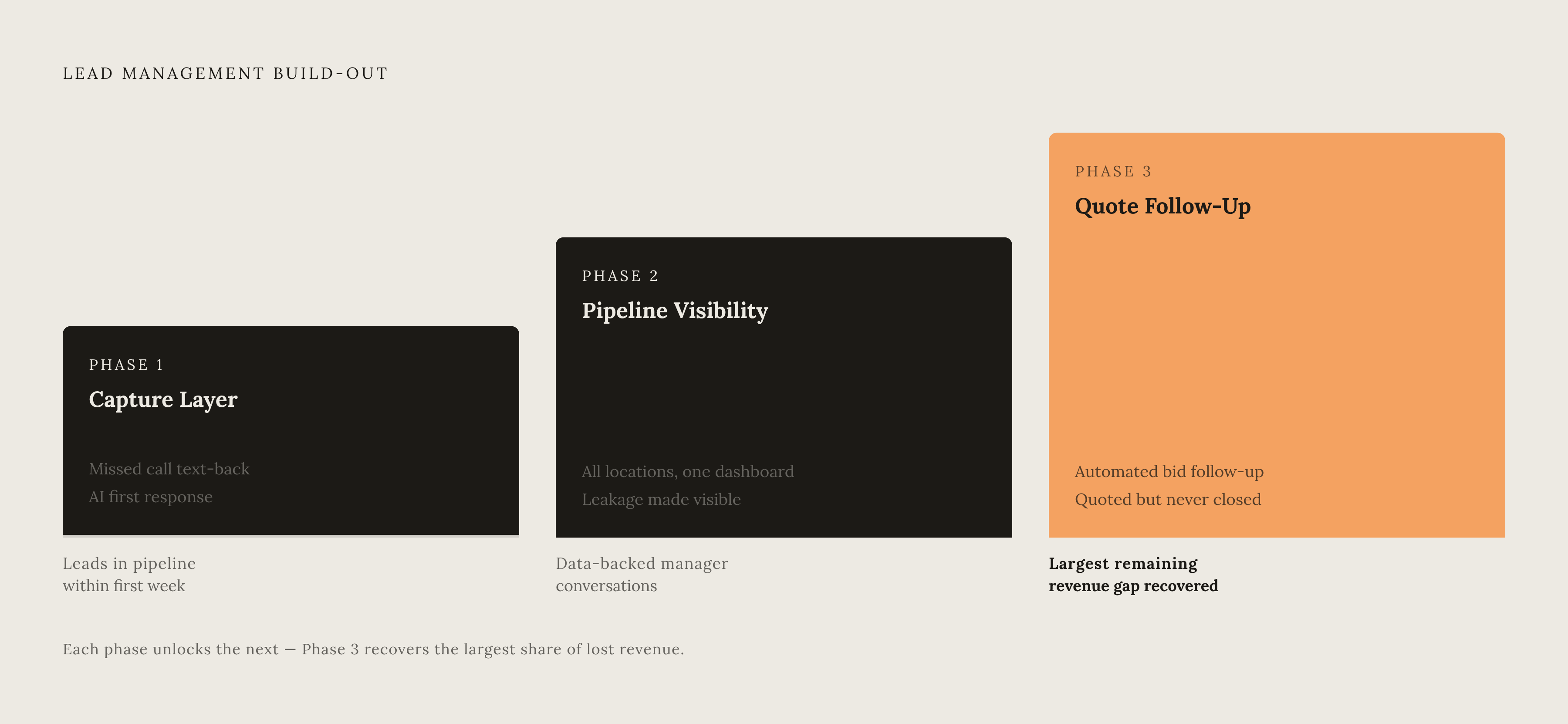
Operators who've actually built this out across locations converge on the same architecture: one capture and engagement layer that every location feeds into, one visibility layer the operator checks from a single dashboard, and a set of automated workflows that hold the standard without depending on any single location's discipline.
In the finished version of this system, every inbound inquiry, call, web form, chat, paid lead, referral, lands in the same pipeline no matter where it came from or which office it contacted. Every lead gets an automated first response within minutes, day or night, regardless of which location picked up the inquiry. Every outstanding quote gets followed up on a set schedule without a rep having to remember. And the operator can see, broken out by location, lead volume, response time, quote rate, follow-up completion, and close rate, and can act on a problem spot without driving to the office.
Most operators start at the capture layer, because the speed-to-lead gap pays back the fastest. Putting missed call text-back and AI first response in place recovers leads that are currently expiring without anyone noticing, and the change shows up in the pipeline within the first week.
The second phase is pipeline visibility: connecting every location's lead data into one shared dashboard so the leakage points that used to be invisible become obvious. That's also the point where conversations with location managers stop being anecdotal and start being backed by actual numbers.
The third phase is automating quote follow-up. Once capture and visibility are both running, automated bid follow-up consistently recovers the largest remaining chunk of lost revenue: jobs that were quoted, never followed up on, and lost to silence.
Operators who try to build all three layers at once with a patched-together stack, one CRM, one automation tool, one reporting platform, tend to stall out during integration. Starting with a platform that handles capture and engagement natively, then adding the visibility layer once those workflows are running smoothly, gets an operator to a working system faster than trying to stitch three separate tools together from day one.