AI Recruiting Tools for Home Service Business Owners
Speed up hiring by automating screening and scheduling.
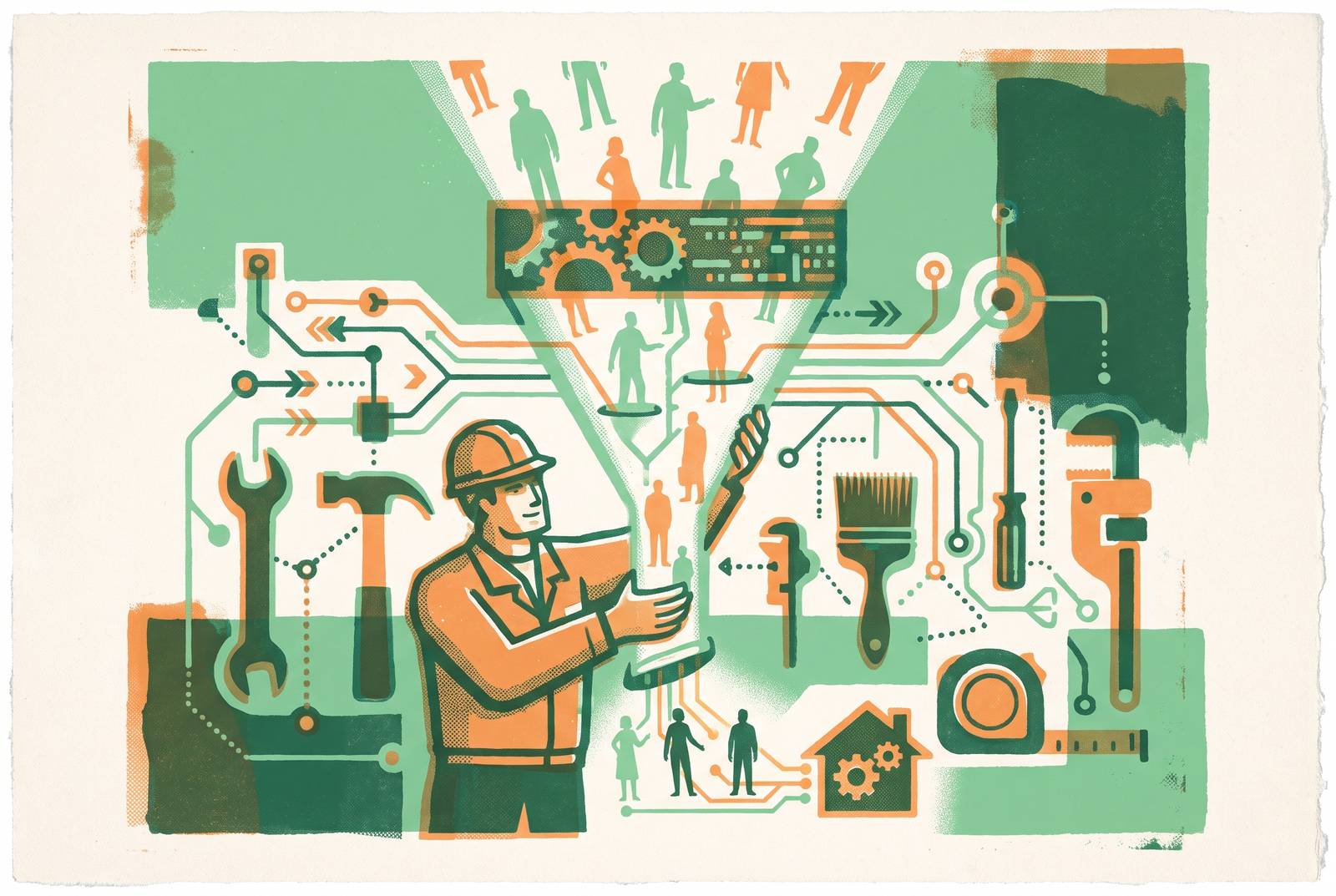
AI recruiting tools for home service business owners can shorten the work between needing a technician and meeting a qualified candidate. Their strongest use is automating job posting, screening, scheduling, and follow-up so a small shop can respond at the speed of a large operator. The hiring decision stays with the owner. The right tool cuts the wait that is costing the business candidates and leaves out features it will rarely use.
Why trades hiring is structurally harder than other small-business hiring problems
The Bureau of Labor Statistics expects demand for HVAC technicians to grow faster than the national average through 2032. That puts owners in a market where demand for skilled workers is outpacing the supply of trained people. Specialized trade workers are the hardest roles to fill, followed by crew leaders and supervisors, then installers and field staff. Effort alone cannot close that supply gap. An owner still has to find and engage qualified people while running jobs and managing crews.
An owner posts a job, waits for applications, reads resumes, makes calls, and tries to arrange interviews. In that time, a competitor that uses automated outreach can screen, interview, and send an offer before Monday morning callbacks begin. Candidate ghosting makes the timing unforgiving because applicants who hear nothing move on, often within hours. Addressing that mismatch means looking at each hiring stage separately, from finding candidates to keeping the people who accept.
What AI recruiting tools actually automate across the hiring funnel
AI recruiting tools intervene at four stages, which are sourcing and job distribution, resume screening and ranking, candidate engagement and scheduling, and interviewing and assessment. Each stage solves a different delay. A tool that finds people who might fit the job may still leave the owner to sort the applications that come in or book interviews. Most tools specialize in one or two stages, so a full AI-assisted process usually needs either a platform covering several stages or connected tools. That map is more useful for evaluating software than a broad claim that it “uses AI.”
The way AI fits into the system also affects its usefulness. An AI-native tool has AI built into its data model, so matching can use the full context as notes and messages go into the same model. An AI-powered tool may instead add an AI module beside an older system, which affects whether recommendations improve over time. A person still needs to make complex diagnosis calls and safety-related decisions, have conversations that matter to high-value relationships, and talk with a candidate who needs to feel heard.
How AI handles job posting and early-stage sourcing for trade roles
Traditional job boards can produce large applicant pools, but sponsorship fees and unqualified applications consume money and time before an interview happens. Multiposting platforms put a job opening on several boards at once, so the owner does not have to post it over and over. Reach alone does not improve candidate quality. Distribution is useful infrastructure, but it is not the same as AI matching.
AI sourcing changes the starting point by searching for people who fit role criteria, including those who have not applied. Juicebox searches a large profile database using plain-language queries rather than Boolean strings, the search commands that otherwise require sourcing knowledge. Instead of waiting for the right person to see a posting, the owner can search for a match.
Workable has an applicant tracking system, or ATS, along with AI sourcing from a large profile database and AI that helps write job ads. That makes it suited to teams that want to find candidates and track them in one system. For an owner who already gets enough applications, though, more sourcing may not solve the main problem. Separating those applicants into people worth interviewing and people who do not meet the role criteria still takes work.
Resume screening and ranking — where AI saves the most time per hire
With manual screening, someone has to spend time on every application. In a shop without dedicated HR staff, that someone is often the owner or a manager who also has jobs and crews to run. Reading dozens of unqualified resumes before finding a viable candidate has a hard dollar cost, even when no recruiting invoice records it. AI screening can turn hours of sorting into minutes by reading and ranking applications based on criteria the business has set. The gain is focused attention.
Truffle reads resumes, runs one-way interviews, and ranks candidates with visible reasoning. It offers a free trial and suits lean teams handling a high volume of applications. Manatal has a low-cost ATS that scores and recommends candidates from the business’s internal applicant database. That distinction limits what its matching function does. It helps sort people already in the system rather than searching an external database for new prospects.
Greenhouse illustrates the more structured end of the market. Its Talent Matching ranks applicants against the job and AI scorecards, with access across Core, Plus, and Pro through the Real Talent add-on. All pricing is custom quoted after a demo. That is a better fit for structured mid-size hiring than for a small trades shop. Across these options, the useful outcome is the same kind of time shift, with less attention spent on unsuitable applications and more available for candidates who warrant a conversation.
Automated candidate engagement and interview scheduling
The gap between application and first contact is where trades hiring loses the most candidates. A strong applicant who applies Friday evening and hears nothing until Monday may already be in a competitor’s process. The owner is usually in the field. Automated engagement closes that gap by replying, screening, and setting up the next step without waiting for the owner to have a break between jobs.
Paradox uses its Olivia chatbot to screen candidates, answer their questions, and book interviews by text. Now part of Workday, it uses contact-sales pricing and is strongest for high-volume and franchise-scale hiring. GoodTime specializes in AI interview scheduling and candidate communication, with a focus on enterprise coordination. Humanly offers conversational AI for screening, scheduling, and interviews as a mid-tier option.
Automation still needs a clear handoff to a person. When a candidate asks something the AI cannot answer accurately, or the conversation calls for trust-building, a human takes over. Quick contact can keep a candidate engaged, but it does not settle every concern about taking a job. The system’s job is to preserve the opportunity for that conversation.
AI-conducted first-round interviews and what they can and can't assess
AI interviewers can screen many people in the first round, leaving the owner to speak with candidates who meet the requirements set for that round. The format varies by tool. Truffle uses one-way video interviews and assessments as part of its screening workflow, so candidates record their answers and reviewers get scored, ranked results with visible reasoning. HireVue has structured video interviews with AI scoring and assessments that use games. Its enterprise-grade offering is priced accordingly and is not a fit for most independent trades businesses.
The useful assessment is narrower than a full judgment of the person. AI interviews can check whether candidates explain experience that fits the job, how they answer standard trade-role scenarios, and how clearly they communicate. Those answers can help decide who moves on to the next hiring stage. They do not establish hands-on skill or judgment under pressure in the field. Nor do they provide the reliability signal that comes from a reference check or a working interview.
That limit does not make the first-round screen pointless. Time spent asking routine opening questions has an opportunity cost in jobs not quoted and estimates not followed up. Automating those questions can reserve the owner’s time for the assessments that require a person. AI first-round screens are a legitimate part of trades hiring for preliminary qualification as long as the owner keeps the final decision.
Onboarding, retention, and workforce forecasting as extensions of the recruiting system
Hiring a technician only pays off if the business keeps that person long enough to make the recruiting cost worthwhile. If a new hire leaves within the first months, the owner faces that cost again while reopening the vacancy. Faster screening does not solve that loss. A recruiting system that stops at the offer letter leaves onboarding and retention disconnected from the effort spent finding the person. Linking those stages gives the business a way to cut the cost of recruiting and keep people from leaving again and again.
NurtureMe connects recruiting with onboarding, retention, and team management in one platform. Its features include workforce forecasting, gamification-driven engagement, and integrations with existing CRMs and payroll tools. Forecasting helps trades businesses plan hiring before a busy season or a planned step in growth, while there is still time to keep a truck from going empty.
NurtureMe uses gamification-driven engagement as a trades-specific retention approach, reflecting that field workers respond to visibility into their performance and recognition alongside compensation. This gives the platform a role after onboarding. The connection to recruiting cost is direct because losing the person sends the owner back to sourcing, screening, and interviewing. A broader platform therefore addresses a different constraint from a tool built only to process more applicants.
How to evaluate an AI recruiting tool as a home service business owner
To choose a tool, start with the delay or loss that costs your business the most. Too few applicants points toward sourcing, while too many unqualified applicants points toward screening. Slow first contact calls for engagement and scheduling support. Early departures point toward onboarding and retention. A focused tool that solves the real constraint is a better choice than a comprehensive platform that addresses everything weakly.
Next, check how well the system fits trade roles, since how well an ATS works for those roles can vary. Generic platforms built for corporate and tech hiring were not designed around HVAC, roofing, pest, or solar roles. Look for trade-specific screening criteria as well as a fit with the candidate pool those jobs draw from. Integration deserves the same scrutiny as matching. A tool that does not connect with the CRM, scheduling software, or payroll system creates another data silo instead of moving information forward into onboarding.
Pricing structure helps reveal the intended customer. Manatal’s low per-seat monthly rate and Juicebox’s higher per-seat rate suit small teams, while Truffle’s credit-based monthly tiers suit businesses with variable screening volume. Enterprise contracts from Greenhouse, HireVue, and Paradox are built for organizations with dedicated HR staff and hiring at scale. Setup time is another practical filter. Look for a system that can begin handling applicants quickly, rather than taking weeks to configure before it processes an application.
Tools that explain why a candidate was ranked or flagged, such as Truffle’s visible reasoning, let the owner judge the result. Black-box scoring creates compliance risk and removes the owner’s judgment from the process. That is the wrong trade-off for faster hiring. The buying standard is a tool that removes waiting and repetitive work while leaving the owner able to question who advances and why.