Follow-Up Cadences for Unconverted Remodeling Estimates
Systematic follow-up after estimates closes the six-to-eighteen-month gap most contractors ignore.

Picture the estimate sitting in a homeowner's inbox right now: measurements taken, materials priced, a number typed up and sent. Then nothing. No call, no text, no second touch. That silence is where most remodeling revenue actually dies, and it has almost nothing to do with the number on the page. The average contractor converts only 6% of leads into paying customers. The overwhelming majority of estimates, with all the driving, measuring, and pricing labor baked into them, produce zero dollars back.
That is a systems problem, not a pricing problem. It is not even a sales skill problem, in the way most contractors assume. Builder leads go cold because of a chain of systematic failures: slow response times, follow-up that stops after one or two tries, and almost no nurturing built for the 6-to-18-month window that big remodeling decisions actually take. A homeowner planning a renovation is not deciding in 48 hours. But most follow-up systems are built as if they are.
The structural gap is easy to spot once you look for it. Leads move from quoting to a folder, a sticky note, a spreadsheet row nobody owns. There is no defined owner, no timeline, no trigger that says "call this person again on day 14." So when a contractor says "we follow up when we have time," that is not a scheduling problem. That is the diagnosis. Discretionary follow-up is what happens in the absence of a system, and a business that depends on discretion to generate revenue is gambling with its own labor costs every time an estimator drives out to a job site.
The fix is not a sales technique. It is a cadence, built with the same rigor as a materials order or a project schedule: defined timing, defined channels, defined exit points. The rest of this piece builds that system stage by stage.
Decision psychology of remodeling homeowners and its implications for follow-up
Generic check-ins fail for a specific, fixable reason: they ignore why the homeowner asked for an estimate in the first place. Most contractors ask the wrong qualification questions. They dig into budget and timeline, but skip past the emotional trigger that is actually driving the decision. A follow-up cadence built on budget and timeline alone will keep asking "did you make a decision?" to someone who was never going to answer that question honestly.
The practical upgrader fixing something that no longer functions, the retiree investing in quality of life for the years ahead, and the owner of a newer or long-held home who wants the property to finally feel finished are three homeowner profiles that recur repeatedly in high-value remodeling and hardscaping work. Each one has a different trigger and a different bar for trust. The upgrader wants proof the problem gets solved. The retiree wants confidence in a long-term investment. The finish-line owner wants to see the outcome before committing to it.
An unconverted estimate, in nearly every one of these cases, is not a rejection. It is a homeowner still comparing options or still building the confidence to spend. The cadence's job is to move that person through comparison and toward confidence, not to re-explain the price. So every message in the sequence should reference the specific project discussed, speak to whatever pushed the homeowner to call in the first place, and hand over some form of proof, a past project, a review, a photo, that confirms they are choosing well. That logic produces everything that follows, and the text that comes next shows it.
Speed to first follow-up as the single highest-leverage variable in the cadence
Before channels, before message sequencing, before anything else, there is the matter of how fast the first contact happens. This is not a discipline problem. It is an infrastructure problem, and it is the single most fixable one in the entire cadence.
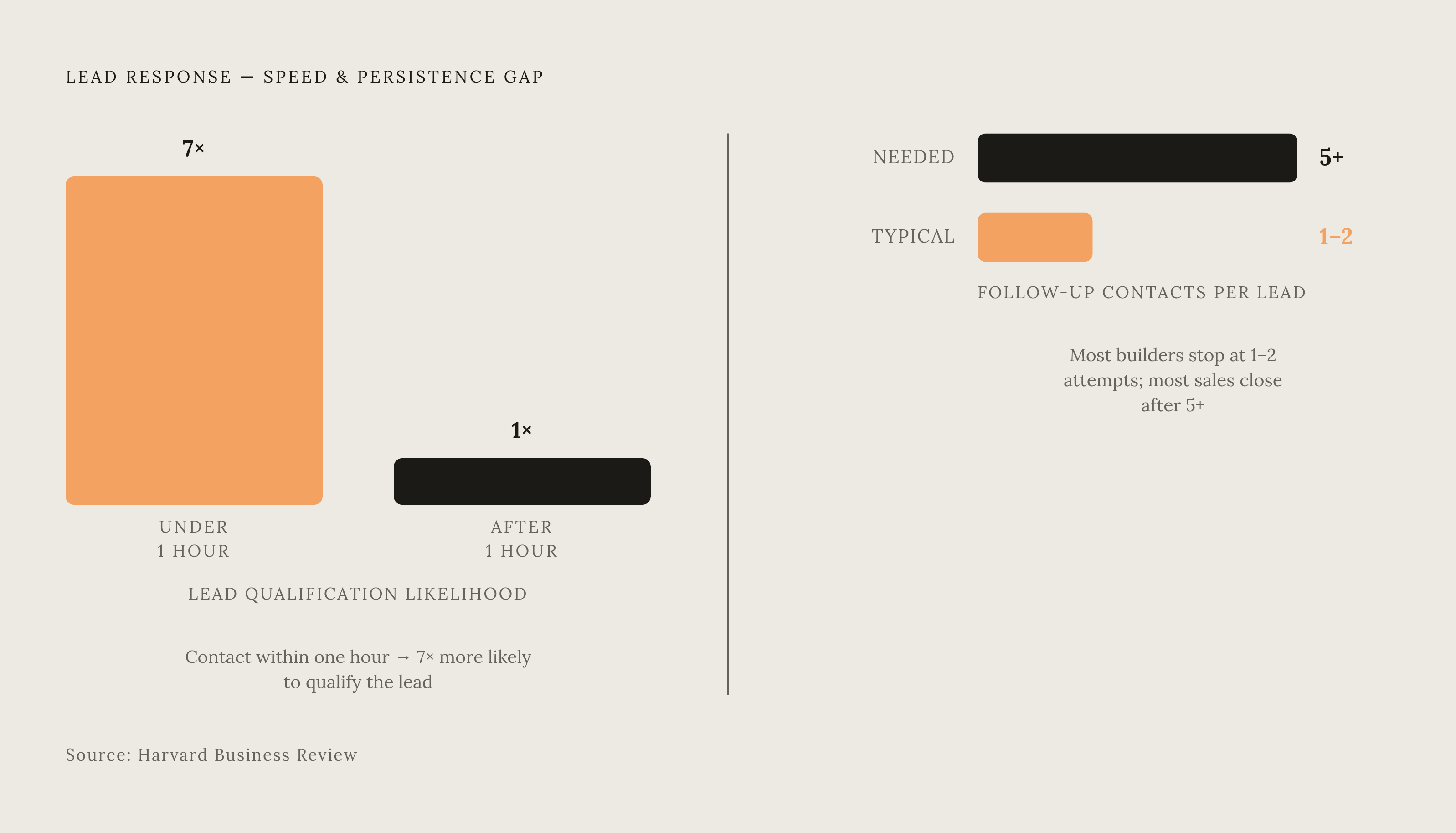
The average builder takes far too long to respond to a new lead. Companies that make contact within an hour of an inquiry are nearly seven times more likely to qualify that lead than companies that wait even a single hour longer, a gap traced back to Harvard Business Review research. Seven times marks a decisive edge. It separates a functioning pipeline from a leaking one.
The mechanics are simple enough to picture. A homeowner requests three estimates on a Saturday morning while sitting at the kitchen table with a notepad. By Monday, she is ranking those three contractors in her head, and the first one who responded professionally and followed up sets the reference point the others are measured against. Whoever responds first owns the frame.
Speed alone is not enough, though. NAHB research finds that most sales in this industry require five or more follow-up contacts after the initial meeting, yet most builders give up after one or two attempts. That persistence gap does nearly as much damage as the speed gap. And a lot of the highest-intent moments happen outside business hours entirely, evenings and weekends, exactly when a homeowner has time to sit down and actually think about the project.
None of this requires an owner to be reachable around the clock. It requires a designed response: an automated acknowledgment the instant the estimate request lands, followed by a real phone call within the first working hour. That is a system decision.
The structure of a multi-touch follow-up cadence (timing, channels, and message intent at each stage)
A cadence is not a call log. It is a defined sequence, and the governing rule behind it is straightforward: every lead in the pipeline either signs, disqualifies, or stays in active nurturing. "Contacted" and "waiting for callback" are not statuses. They are what a system looks like when it does not exist yet.
Early stage, the first few days, is where speed does its work: the immediate acknowledgment, the personal call within the hour, a same-day recap that confirms the estimate arrived and restates the project detail the homeowner cared about. This stage is short and phone-heavy, because phone carries the most signal when trust is still forming.
Mid stage stretches out. The recommended architecture calls for a substantial series of touchpoints spread across many weeks at minimum, not front-loaded check-ins, since the cadence must be built for the extended decision cycle of high-ticket residential projects. This is where channel choice starts to matter. Text works for short, time-sensitive nudges, confirming a site visit window, flagging a material lead time. Email carries the longer trust-building material, project galleries, a short case study, a note about a similar job just finished nearby. Phone stays in reserve for anything that needs a real conversation, an objection, a change in scope, a question about financing.
NAHB research finds that the majority of sales require five or more follow-up contacts after the initial meeting, yet most builders stop after one or two attempts. Each touch in this stage should have one job: confirm the homeowner is still in the 6-to-18-month window, surface a new piece of proof, or ask a single question that moves the decision forward. A touchpoint with no defined intent is just noise, and noise is what makes a homeowner unsubscribe.
Exit criteria matter as much as entry criteria. A lead that explicitly says no, requests no further contact, or has gone 12 months past their stated timeline without re-engaging should exit the active cadence and move to a dormant reactivation pool. Leaving them parked in an active sequence forever just clutters the pipeline and buries the leads that are actually still warm.
AI automation and cadence execution without making high-ticket homeowners feel processed
Once automation enters the conversation, a homeowner about to spend tens of thousands of dollars on a kitchen or a backyard raises the objection almost immediately: they do not want to feel like they are talking to a bot. That skepticism is earned. Automated messages a homeowner recognizes as machine-written can actively damage credibility on a high-ticket project, because trust is not a nice-to-have here, it is the precondition for the signature.
The resolution is a clean division of labor. Machines handle timing, routing, and routine communication: the instant acknowledgment, the reminder before a scheduled call, the monthly nurture email that keeps a mid-stage lead warm. Humans handle the first real conversation, the estimate walkthrough, and anything where a homeowner has raised a concern or an objection. The test is simple: would this message feel personal if the homeowner knew a person wrote it? If yes, automate it. If it would sound canned coming from a person, it will sound worse coming from software.
The results back up the approach when it is built this way rather than as a mass blast. AI-driven emails see notably higher open rates than standard campaigns, and personalized sequences produce substantially more conversions than generic ones, but only when the content is specific to the actual project and the actual homeowner. Generic automation at scale just gets ignored faster than a generic human email would.
The intake end shows what this looks like in practice. Crewy integrates with lead sources including Thumbtack, Yelp, SMS, and contractor websites, using AI to read job photos, descriptions, location, materials, and scope of effort, then generates a quote and books an appointment, typically inside 20 seconds. That compresses the entire speed-to-contact problem down to something a contractor without a full-time intake staffer can still compete on.
The bigger platforms are moving the same direction. Scorpion Convert, launched in October 2025, and ServiceTitan's Atlas, announced the same year, both point toward vertical software absorbing lead follow-up cadence and timing at the platform level. Contractors still running the process off a spreadsheet are going to feel that gap widen, not shrink. Hardscape Mag runs on the same principle: AI agents handle the timing and routing work of follow-up, quoting, and lead management, while the contractor keeps ownership of the relationship moments that actually close the job.
Reactivating cold estimates, the dormant pipeline most contractors are ignoring
Every contractor who builds a forward-looking cadence eventually runs into the same overlooked asset: a list of old estimates that already exists, sitting untouched, in whatever CRM or spreadsheet they use. That list is often the fastest revenue available, and it requires zero new leads to tap.
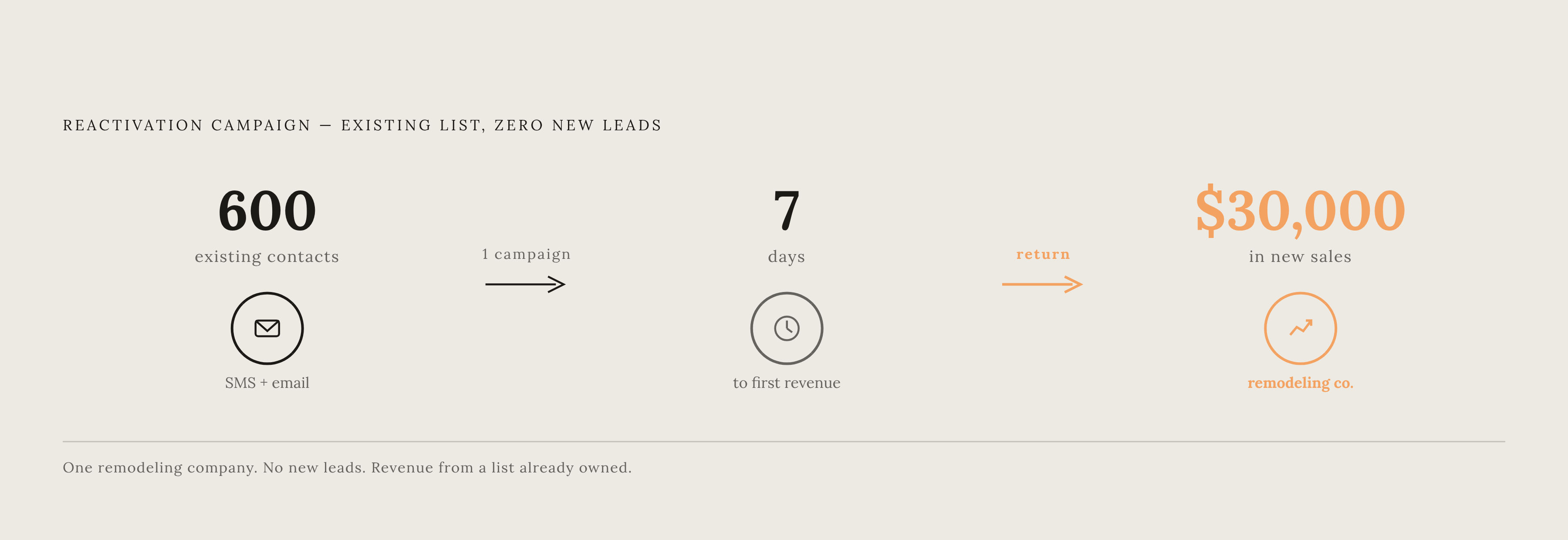
One remodeling company's numbers make the case bluntly. A single SMS and email reactivation campaign sent to 600 existing contacts generated $30,000 in sales within the first seven days, before a single new lead came in the door, money that was already sitting in a contact list. That is not a marketing win. That is money that was already sitting in a contact list, waiting for someone to send the right message.
Cold leads are not dead leads. They are leads whose timing happened to be wrong. A homeowner who got an estimate eight months ago and went quiet might be six weeks from finally pulling the trigger, but if the contractor gave up after two unanswered calls, that homeowner is not calling back. Silence on the contractor's end reads as disinterest, even when the homeowner was the one who paused.
Reactivation messages need to look different from active-cadence messages. They should acknowledge that real time has passed, name the original project specifically, and offer a concrete reason to pick the conversation back up, an open scheduling window, a material update, a finished project of similar scope completed since the estimate went out. Before any of that goes out, the dormant list needs a quick audit against exit criteria: anyone who explicitly declined, asked not to be contacted, or fell outside the service area gets excluded. Everyone left over is a real candidate.
What pre-qualification upstream does for cadence effectiveness downstream
A cadence run against every single estimate, regardless of fit, burns team time on leads that were never close to signing. The fix sits upstream of the cadence entirely: pre-qualification, done before the estimate appointment even happens.
One remodeling company's jump to a consistent 25% lead-to-customer conversion rate did not come from better sales skill or sharper pricing. It came from a qualification system that screened for psychological readiness before the appointment, so the estimator was only sitting across from homeowners actually prepared to invest. That system looked for decision urgency tied to a real trigger, movement past pure price comparison into evaluating quality, genuine emotional investment in the outcome, and responsiveness to social proof.
That scoring should feed straight back into cadence design. A lead that scores high on urgency and readiness warrants a tighter, faster-escalating sequence, more touches, quicker movement to a senior conversation. A lead showing no real trigger and pure price-shopping behavior warrants a lighter nurture track, or an earlier exit. Pre-qualification is about how hard the cadence should work on each lead, not just which leads to take. It is about how hard the cadence should work on each one.
A short intake survey completed before the estimate appointment does double duty here: it gathers the information that determines cadence intensity, and it signals professionalism to the homeowner before the estimate is even delivered. The marketing layer can do the same work earlier still. A well-built remodeling website does more than collect names and phone numbers, it shows project types, service areas, price range, and process clearly enough that the right homeowner moves forward and the wrong one filters out before ever picking up the phone.
The AJ Ballantine and Cornerstone Remodeling case shows what this whole system looks like once qualification and cadence are both running. One salesperson closed an exceptional volume of remodeling projects in a single year, using a structured sales process, automation tools, a defined follow-up strategy, and the Render estimating tool, without adding a single additional rep or appointment. That is not a story about one gifted salesperson. It is a story about what happens when the right leads enter a system built to actually follow through on them.