How Independent Remodeling Contractors Win Against National Franchise Competitors
Independents beat franchises by cutting royalties, controlling pricing, and moving faster.

Independent remodeling contractors can beat national franchise competitors without taking on the same costs. Their advantages are concrete, including no royalty drag, control over pricing, direct local accountability, and faster decisions. Those advantages have to shape a repeatable system for marketing, quoting, and closing to win work.
Why the remodeling franchise wave creates an opening for independents, not a threat
Private equity has been rolling up franchise platforms for well over a decade, giving independent remodelers better-funded, more organized competitors. FirstService Brands, the franchise division of publicly traded FirstService Corporation, houses Paul Davis Restoration, Floor Coverings International, and California Closets. Stellar Service Brands owns Restoration 1. The 2025 combination of Leaf Home and Erie Home drew preferred equity from Ares and debt from Apollo, with Ares also participating in the debt.
That backing matters because independents are competing against more than a familiar logo. They face businesses with organized sales processes and the resources to maintain broad visibility. But consolidation does not remove the costs that individual franchisees carry, nor does it erase demand driven by aging housing stock. An independent can compete by serving local homeowners with less overhead and equal sales discipline.
The royalty drag franchisees carry that independents never pay
Royalties create the clearest difference between the two business models. Franchise Clues' 2026 FDD analysis lays out what franchisees pay in royalties and ad-fund charges based on gross revenue, regardless of profit, across major remodeling and home improvement brands. A franchisee owes the charge even when a job makes little profit or none. An independent has no such charge to pay on each sale.
That difference leaves the independent more room to price a project competitively or retain profit. On a high-ticket hardscape or remodeling job, the royalty equivalent is money that can materially change the bid. It is a specific cost advantage that remains available if the contractor manages the costs of running the rest of the business well.
The fair objection is that franchisees receive something in return, including a brand, systems, and lead flow. But an independent can build or buy equivalent operating capabilities at their own cost.
How franchises spend on marketing — and why that overhead is an independent's opening
Advertising also takes a share of the franchisee’s margin. National franchise systems spend to maintain brand awareness at scale, with costs passed through advertising funds or reflected in the prices homeowners pay. The contractor needs enough qualified demand within the area the business serves.
That narrower task changes the spending decision. An independent can concentrate marketing on nearby homeowners. They can build the same local lead flow without paying for the same national advertising overhead.
When targeted marketing also lowers the cost of each lead, the independent gains room beyond the royalty savings alone. That money can support a more competitive price or additional crew capacity. But cheaper leads only pay off when they turn into projects that fit the business. Marketing efficiency therefore depends on reaching homeowners who have a reason to trust the contractor.
The local relationship advantage that no franchise playbook can replicate
A homeowner committing to a large remodeling project is buying a working relationship as well as finished work. The practical backyard upgrader, the retired life-quality improver, and the new- or legacy-home upgrader share a basic concern. They want confidence that the person quoting the job will be involved in delivering it. They also want to know who answers when something goes wrong. A familiar brand can offer reassurance, but it cannot fully substitute for that direct accountability.
The independent model makes the connection between the business and its owner clear. A franchise separates the national brand from the individual operating unit, while an independent owner answers directly for the work. When the owner works on site, the business should say so in sales conversations and marketing materials. It should not be left for the homeowner to infer.
Local evidence makes that promise more credible. A neighbor’s referral, a finished project visible from the street, and a five-star review naming the owner connect the business to work nearby. Nextdoor and neighborhood Facebook groups can amplify that reputation among people interested in the same area. Advertising can buy attention, but it cannot manufacture the history behind those recommendations.
Pricing flexibility — how independents can undercut, hold margin, or do both depending on the job
Lower structural overhead gives an independent choices. On a price-sensitive project, royalty savings and lower marketing costs can support a more competitive bid. On a high-value project, the contractor can hold the price and retain more margin. At the same price point, those savings can instead fund better materials or craftsmanship. The right use depends on the job and what the homeowner values.
A franchisee has to account for royalties, advertising funds, and any corporate pricing minimums. An independent can set the quote without those same limits. On a large remodeling or hardscape project, that freedom can support a stronger warranty, a faster completion timeline, or a lower price. It also works upward, because demonstrably better craftsmanship and accountability can justify pricing at or above franchise rates.
A contractor who sends an attractive estimate and never follows up can still lose the work. Pricing latitude has value only when the business closes enough of the opportunities it creates.
Speed of decision as a competitive weapon independents underuse
An independent owner can make pricing, scope, and scheduling decisions in the same conversation. There is no separate corporate approval needed to exercise that authority. By contrast, franchisees may work within approved pricing bands, required product lines, and centralized scheduling systems. Each can make a homeowner wait longer for a firm answer. When competing quotes are similar, a detailed proposal delivered promptly can make the decision easier.
But having authority is not the same as using it quickly. A contractor cannot benefit from fast decisions if the homeowner’s call goes unanswered while the owner is on a job site. An estimate waiting for follow-up creates the same problem. So does an after-hours inquiry that has no process for handling it.
Fast response, prompt quoting, and consistent follow-up make the owner’s decision-making freedom useful to the customer. Without them, independence offers only the capacity to move faster.
Why franchises are winning on sales systems — and what independents can learn from it
Franchises deserve credit for treating selling as a process. Their playbooks can include structured in-home presentations, scripted upselling, financing offers, and trained closing sequences. Those steps help explain options and make a larger scope more accessible to the homeowner. Follow-up sequences then re-engage people who did not commit during the first visit.
The weaker independent approach is to inspect the project, send a number, and wait. Without an organized presentation, financing offer, or plan for a second visit, the homeowner has fewer chances to talk through doubts. Without follow-up, the contractor also leaves the next move entirely to the buyer. A good price and strong craftsmanship do not fill that gap on their own.
Franchise sales systems support more predictable revenue per job because the process does not end with the quote. Independents can work in the same way without paying the royalties that fund those habits inside a franchise.
How AI-powered lead response and follow-up close the systems gap for independents
AI tools address the specific failures that interrupt an independent’s sales process. They can handle inbound call answering, lead qualification, appointment scheduling, quote reminders, and after-hours inquiry capture. That lets people who get in touch take the next step while the owner is busy on a job. It also means a sent estimate does not have to become an abandoned conversation.
Quoting is another part of the same gap. A detailed, professional estimate delivered within hours of a site visit keeps the process moving better than a delay of days. AI-assisted estimating can shorten that turnaround without requiring additional office staff. However, faster preparation is not a substitute for the contractor’s responsibility for the scope and price.
ServiceTitan and Housecall Pro link dispatch, customer relationship management, and billing so the same information is shared across the tools. These connected systems let independents do things that usually call for a larger business. They still cost money and require an organized process, but they do not impose a franchise royalty. Their value is making the independent’s existing pricing and relationship advantages easier to convert into signed work.
Building a local marketing system that compounds where franchise ad spend cannot reach
With response and follow-up in place, targeted local marketing has somewhere productive to send demand. Google Business Profile, the local map pack, and Local Services Ads are starting points because they focus on geographic relevance. A strong local profile and consistent five-star reviews give homeowners evidence about the business that would actually do their work. National awareness does not automatically supply that evidence for an individual franchise unit. The independent’s task is to make nearby experience easy to find.
Neighborhood channels extend the same approach. Nextdoor and neighborhood Facebook groups show examples of projects and recommendations to people who already want to know about work nearby. Photos that show a project as it takes shape, before-and-after documentation, and posts that explain material choices build a portfolio in place of a stream of separate ads. Each addition gives the next homeowner more local evidence to consider. Templated national content cannot stand in for that record of specific work.
The business also needs to use the same details about itself on its website, Google Business Profile, Yelp, and directories. Using the same business name, address, phone, and category helps with entity consistency when homeowners use AI search tools to find contractors. That is part of Answer Engine Optimization, but the practical work is straightforward. Royalty and ad-fund savings can be reinvested in this local presence.
Turning the structural advantages into a repeatable system for marketing, quoting, and closing
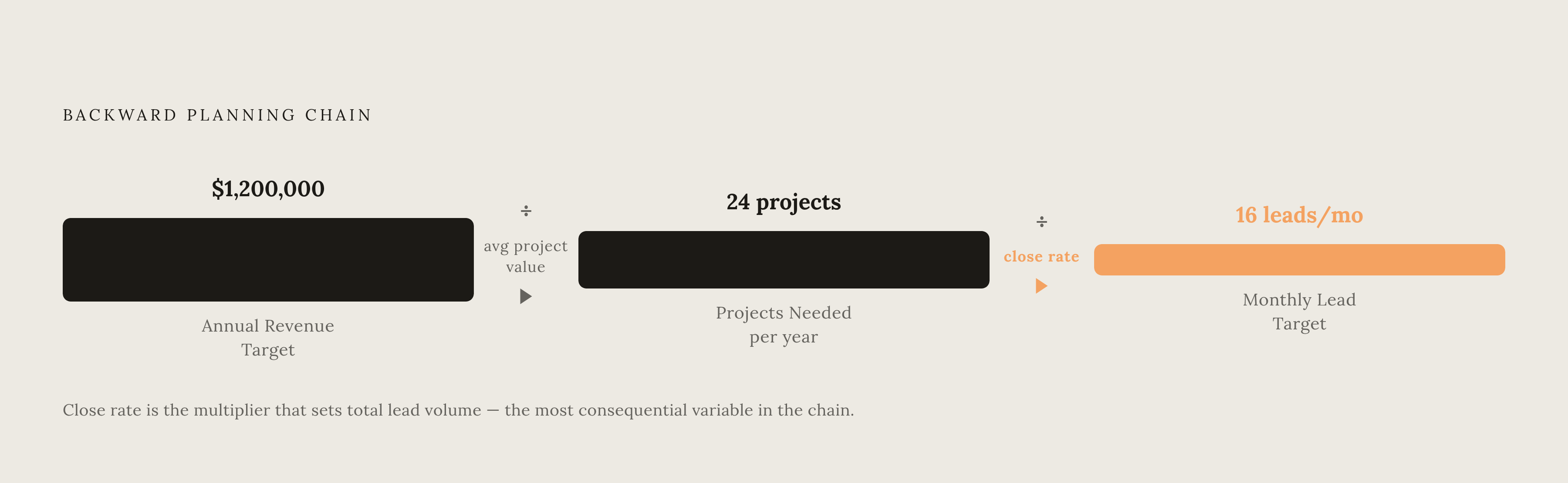
The operating model has three connected parts, namely local marketing that attracts qualified leads, a response process that captures and qualifies them within minutes, and quoting and follow-up that turn them into work. Each part depends on the next. Low-cost demand is wasted if calls go unanswered, and fast answers accomplish little if estimates stall.
Work backward from the annual revenue target to plan that process. Use average project value to determine the number of projects needed, then apply a realistic close rate to establish a monthly lead target. Build response and follow-up before committing heavily to more lead generation. Otherwise, more marketing sends leads into the same gaps and fails to help the business grow. Connected marketing, customer records, quoting, and follow-up make it easier to see where opportunities are being lost.
That discipline changes the competitive position. Independence is not a consolation prize for a contractor who has not joined a franchise. Run deliberately, it is a business model advantage that combines franchise-level sales discipline with costs the independent never has to carry.