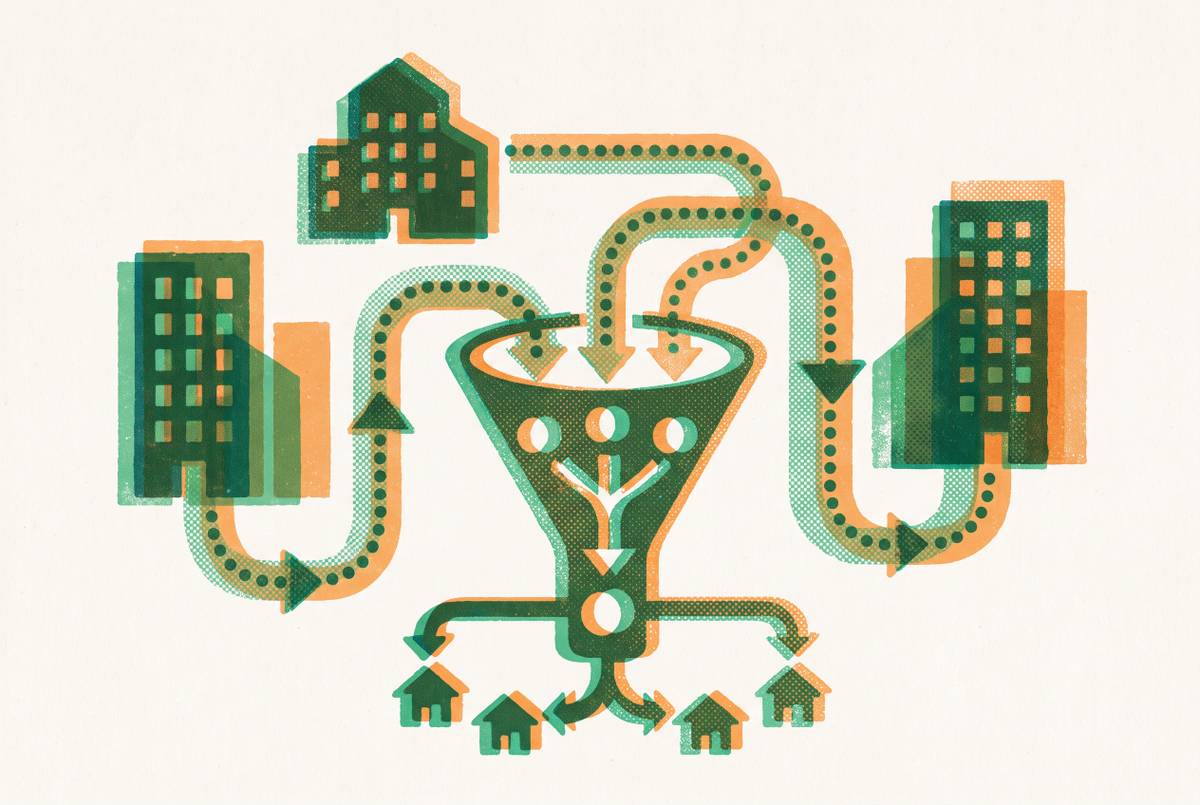
Franchise Royalty Economics vs Independent Overhead in Remodeling
Royalty stacks and recurring charges often exceed the headline percentage franchisees expect to pay.

Franchise royalties in remodeling are never just the headline percentage quoted in a sales pitch. They're a stack of recurring charges, and the real number a franchisee owes is bigger than the number printed on the fee sheet.
Franchise royalty costs in remodeling, beyond the headline percentage
The royalty itself is calculated on gross sales, not profit. That means it comes due whether or not the operator made money that month. A separate brand or marketing fund contribution sits on top of the royalty, and the two are always broken out separately in FDD Item 6, the section of the Franchise Disclosure Document that covers fees. Then there's the initial franchise fee, a one-time charge for the right to open the doors at all, typically running $50,000 to $59,900 for the remodeling brands in question. Royalties in most franchise systems don't bend: changing the rate for one franchisee creates disclosure and fairness problems across the whole system, so the number quoted at signing is the number paid for the life of the agreement.
Putting the dominant remodeling brands side by side shows combined royalty-plus-ad-fund loads clustering around 7% to 9% of gross sales, and you should anchor every comparison that follows to that range. Miracle Method charges a 5.5% royalty plus a 2% ad fund, together the larger part of that combined-load range, against median 2024 gross revenues of $923,778 per owner (based on 73 of 202 reporting owners). That figure is reported per owner, not per territory, and the distinction matters. A per-owner median can include multi-unit operators whose numbers look different from a single-territory franchisee's, so don't treat medians from different brands as apples to apples unless the unit basis matches.
A 6% to 9% combined load on gross sales is a fixed claim on every dollar that comes through the door, on every kitchen remodel and bathroom conversion the franchisee bills, for as long as the agreement runs.
Cumulative royalty burden over a full franchise term
What that rate adds up to once it's paid out over the full length of a franchise agreement, which typically runs 10 to 20 years, is the real argument against royalties, not the rate charged in any one year.
Running the math on a growing revenue base at a combined 8% load puts the five-year total paid to the franchisor into the high hundreds of thousands of dollars, before the initial franchise fee is even added in. The number keeps growing as revenue scales, because the royalty rate never drops as revenue rises. The dollar figure gets bigger every year the business succeeds. And because the fee is calculated on revenue, not on what's left after costs, a 6% royalty charged against a unit running a 10% operating margin can claim a majority of the operator's actual profit. That's the part flat percentages hide: a small-looking rate against gross sales can be a very large bite out of net income.
Royalty structure is also a core input in how franchise businesses get valued when they're bought or sold. CT Acquisitions, a franchise brokerage, has noted that the royalty fee shapes long-term unit economics more than the entry cost does. A franchisee weighing a 20-year term is also weighing what that unit is worth on resale, since an operator approaching the end of a term without a guaranteed renewal holds an asset with a shrinking shelf life. An independent contractor's business equity carries no such ceiling.
So if royalties claim this much of gross revenue over a full term, the next question is straightforward: what does it actually cost an independent contractor to replace everything that royalty is paying for?
What the royalty purchases
The royalty buys a bundle of things, not one thing. Per FDD Item 6 disclosures, that royalty revenue typically funds brand research and product development, maintenance of the operating system, technology platforms for scheduling, CRM, and customer-facing apps, field consulting and support, legal and compliance work, and training programs. The honest question for a contractor is whether each piece of that bundle is worth its share of the ongoing fee, or whether it can be built or bought independently for less.
Some of it isn't optional either way. Brands operating at the scale of ReBath or Kitchen Tune-Up require a showroom and a staff of designers and installers, and those costs exist for every operator at that scale, franchised or not. CT Acquisitions' 2026 brand analysis points out that remodeling is the most expensive franchise category to enter precisely because it demands a showroom, a fleet, and trained staff before a single job is sold. An independent carries that same capital requirement. The franchise just wraps it in a brand name and a fee.
Where the comparison tilts is in the parts of the bundle that used to be hard to replicate outside a franchise system. An independent once needed scale and capital to get scheduling software, a CRM, automated follow-up, and marketing tools. That's no longer true. Standalone software now covers most of that ground at a fraction of the royalty's cost. Wonderly, for example, offers a free software stack built around AI agents for marketing, sales, lead handling, quoting, and design, aimed specifically at independent remodeling and home service contractors trying to close that systems gap without signing up for a royalty.
Brand recognition is the one piece of the bundle that's genuinely harder to replace and deserves a fair hearing. It has real value in markets where a national name is well known. But the remodeling landscape itself undercuts how much weight that advantage carries: of the more than 75,000 remodeling firms operating nationwide, fewer than 4% fly under a national brand. The overwhelming majority of the competition an independent faces is also unbranded. A well-reviewed independent with solid local SEO and an active Google Business Profile builds trust signals that function, at the local level, a lot like national brand recognition does at the national level.
What independent remodeling contractors spend to run the business
Independent overhead is a real cost, and contractors comparing models sometimes underweight it because the royalty line is the one spelled out in black and white. A fair comparison has to name every cost the franchise bundle absorbs that an independent has to fund on their own.
Marketing is the biggest of these lines, and it's the one franchises partially cover through the brand fund. Local SEO for an independent typically delivers a cost per lead in the low tens of dollars, and that cost tends to fall over time as rankings and reviews build up. Paid search in premium trades like kitchen and bath remodeling costs a good deal more per lead. The technology stack that a franchise bundles into its royalty, covering scheduling, CRM, quoting, and follow-up, can be assembled independently for a monthly software bill that's a small fraction of what a royalty payment runs at any meaningful revenue level. Training and operational know-how come from experience and from hiring crew leaders who already have it. That cost falls as crew leaders gain experience on the job. Insurance, licensing, and compliance cost the same for everyone. Franchise or not, those bills don't change.
Showrooms, fleets, and designer-installer staff aren't unique to the franchise model either. CT Acquisitions' 2026 analysis makes the same point: independent remodelers operating at comparable scale carry the same capital requirements as franchisees at that scale, minus the brand fee layered on top.
What makes the independent's cost structure fundamentally different is timing. The spending is front-loaded: heavier marketing and systems investment in the first year or two, falling as a share of revenue once those systems mature and referrals start doing more of the work. A franchise royalty runs the opposite direction. It scales up in dollar terms as revenue grows, so the better the franchisee performs, the bigger the absolute check written to the franchisor. At a mature $1 million to $2.5 million in annual revenue, an independent running systems equivalent to what a franchise provides keeps the royalty as margin instead of handing it over, which is the structural case for independence once a business reaches scale.
The revenue threshold where each model wins
Neither model wins in every situation. The franchise bundle earns its keep early, when an operator has no brand, no systems, and no marketing infrastructure built yet. The independent model earns its keep later, once those gaps have been closed, and the crossover between the two happens sooner than most contractors expect.
At low revenue, the franchise package, meaning brand recognition, systems, and co-op marketing, can generate enough extra revenue to cover the royalty and then some. The real question for an operator at that stage is whether they'd have hit that same revenue number on their own. Looking at the revenue levels disclosed in FDDs tells the story at the higher end: Kitchen Tune-Up reports median revenue of $361,644 per territory, Mr. Handyman reports $580,422, and ReBath reports $2,548,254. An independent who reaches roughly 90% of that same volume while avoiding the combined 8% fee ends up with net income close to even. Past that point, the independent pulls ahead on retained margin, because every additional dollar of revenue stops carrying a royalty obligation. A thriving ReBath territory running at that $2.5 million median is also handing over a large and growing dollar amount in combined fees every year. Success under a royalty structure means paying more, not less.
Remodeling margins vary widely on both sides of this comparison, so the crossover point depends heavily on how well the business is run. CT Acquisitions' 2026 analysis puts mature EBITDA margins for remodeling franchises at 9% to 15%, and independent home service businesses report a similarly wide range depending on systems discipline, close rates, and pricing strategy. A franchisee leaning on the brand to generate leads while running weak follow-up and poor close rates will lose to an independent with tight systems. Brand name doesn't substitute for operational discipline. The reverse holds too: an independent who can't generate steady lead flow will spend more on paid advertising trying to catch up than a well-established franchise's ad fund would have cost. Co-op marketing earns its value for operators who haven't yet built organic demand on their own.
One more data point belongs in this picture. Franchisees who give up their territories are showing, through action rather than opinion, that the royalty wasn't worth what it cost them. Territory loss has more than one cause, so it isn't proof that a given brand failed everywhere. But as a signal of where the economics stopped working for a specific operator, it's about as direct as the data gets.
The operational gaps that determine whether an independent can close the spread
Keeping the royalty as margin only works if an independent actually closes the gaps the franchise bundle was built to solve. The good news is that those gaps are closable now with tools that simply didn't exist at this price point five years ago.
Speed matters most in the lead-response gap. The time between a homeowner submitting an inquiry and a contractor actually responding is where independent businesses lose the most potential revenue, and it's the single highest-return fix available to any remodeler. Automated response, qualification, and scheduling tools now handle this without adding a single employee to the payroll. Quoting speed matters almost as much: a slow turnaround between site visit and proposal means more leads go cold before they ever get a number back, and AI-assisted estimating compresses that window dramatically. Marketing is its own gap. Franchise co-op advertising bundles multi-channel paid search, local SEO, and Google Business Profile management together, something independents have had to piece together from several different vendors. A single unified platform can replicate that coverage for less. Follow-up closes out the list. Most remodeling jobs don't close on the first conversation, and the systematic follow-up sequences a franchise CRM runs are something any independent can replicate with a proper CRM and automation in place.
Wonderly's free software stack takes aim at exactly this set of gaps: AI agents covering marketing, sales, lead handling, quoting, and operations, built for independent contractors who want one connected system instead of ten disconnected apps and without a franchise's cost structure attached. It earns through a $500 monthly subscription fee plus a percentage of revenue generated, rather than an upfront franchise fee or an ongoing royalty, an alignment that franchise economics simply don't offer: it earns when the contractor earns. Running the full stack, lead capture, CRM, quoting, and follow-up, through one connected system also produces closed-loop measurement that a lot of competitors, including plenty of franchise operators, don't have access to.
One gap doesn't close with software. Hiring skilled trade workers and crew leaders is hard, and franchise brands offer recruiting infrastructure that independents have to build from scratch. It's the least automatable piece of the puzzle. It's addressable by applying that same lead-follow-up discipline to a candidate pipeline.
Reading your own numbers before choosing a model
Choosing between a franchise and an independent operation comes down to a contractor's own revenue projection, their margin baseline, and an honest look at which operational gaps they can realistically close. The framework stays the same for every remodeler, but the answer won't.
Start by pulling the FDD Item 19 financial performance representation for any franchise you're considering, and check whether the figures are reported per territory or per owner before you compare them to anything else. Franchise Clues' 2026 FDD analysis shows that this distinction changes what a median figure actually tells you. From there, calculate the combined royalty-plus-ad-fund load as a share of projected gross revenue, and turn that percentage into an actual dollar figure at years one, three, and five; the compounding effect becomes visible in those dollar figures. Add the initial franchise fee to that cumulative royalty total to arrive at a real five-year cost of the franchise relationship, then weigh that number against what it would cost to build an equivalent set of systems independently. Next, take an honest inventory of each operational gap, brand recognition, marketing, systems, training, and hiring, and sort out which ones are solvable with technology and which genuinely call for the franchise bundle. Finally, check FDD Item 20 for the franchise's territory retention rate.
Remodeling rewards contractors who can command a high average ticket and close at a strong rate, and no franchise brand or software platform replaces that skill. Experienced contractors who already have referral networks, project management habits, and solid crew relationships are the ones most likely to come out ahead as independents, because the gaps they still need to close are technology and marketing gaps, not trade knowledge gaps. Earlier-stage contractors without an established brand or working systems may genuinely come out ahead if they take the franchise bundle for the first three to five years. Paying the franchise premium at low revenue and limited scale can be the right call. The revenue level at which keeping the royalty stops being worth what the royalty buys is knowable for any contractor willing to run it.