Close Rate Benchmarks for Hardscaping and Outdoor Remodeling Companies
Separate close rates by lead source and ticket size to identify what's actually holding you back.

A contractor who checks one close rate number once a quarter and makes decisions off it is measuring the wrong thing. Close rate benchmarks for hardscaping only mean something when they're tied to the variables that actually move them: lead source, average ticket, and the stage of the sales process where a job was won or lost. A single blended number collapses all three into one figure, and that figure can look mediocre, good, or alarming for reasons that have nothing to do with sales skill.
Take a contractor closing a strong percentage of referral leads alongside a weak percentage of paid leads. Blend those two numbers together and the result looks average. But averaging them hides two completely different problems that need two completely different fixes. One is a channel issue. The other might be a nurture or follow-up issue. Neither gets solved by staring at the blended number and wondering why it's stuck.
Ticket size compounds the distortion. A lower close rate on a large outdoor living project can produce more gross profit than a high close rate on a small patio job. A contractor who treats close rate as the goal, rather than gross profit, ends up optimizing the wrong lever. The rest of this piece breaks the single number into the parts that actually explain it.
What the home services conversion benchmarks measure in hardscaping
Most benchmark numbers a contractor finds online conflate two different denominators. One is marketing conversion rate: all leads that come in, divided by how many become paying customers. The other is quote-to-close rate: only the qualified quotes that actually went out, divided by how many turned into signed jobs. These are not the same measurement, and treating them as interchangeable produces a false baseline.
The gap between a mid-range marketing conversion rate and a higher quote-to-close rate isn't noise. It reflects everything that happens in between: not every inquiry becomes a quote. Some leads never get a call back fast enough. Some get disqualified for budget or scope reasons. Some simply go cold before an estimator shows up. How well a contractor qualifies leads and moves them to the quote stage is its own conversion problem, and it disappears the moment someone averages the two metrics into a single figure.
This matters for hardscaping specifically because the industry runs on site visits and custom estimates, not instant quotes. A contractor who only tracks "leads to customers" has no way to tell whether a weak number comes from poor qualification, slow response, or a genuinely weak sales conversation once the quote is in hand. Knowing which denominator is being measured is the first step before any benchmark means anything.
How lead source separates strong from weak close rates
Lead source is the single largest predictor of close rate variance. It determines how much purchase intent a homeowner already has before a contractor ever picks up the phone. A contractor who doesn't track close rate by channel is averaging away the most useful diagnostic signal available.
The spread between channels is substantial. Organic referrals and repeat customers close at the highest rates, because trust and intent are already established before the first conversation. Google Local Service Ad leads close at a meaningfully higher rate than paid social leads, since LSA leads come from someone actively searching for a hardscaping contractor. Facebook and Instagram ad leads close at the lowest rates of the group, because those homeowners were scrolling for inspiration, not searching for a contractor. They saw a project photo that caught their eye, not a solution to a problem they'd already decided to solve.
None of this reflects a weak sales pitch on low-intent channels. It reflects a structural gap in intent that exists before the conversation starts. The fix for a paid social lead isn't a better close, it's a different nurture sequence built for someone earlier in their decision process, or a reallocation of ad spend toward channels that already carry higher intent.
Meta and Instagram ads still earn a place in the channel mix for a visually driven trade like hardscaping. Before-and-after project photos build pipeline and work well as a second or third touch after a homeowner has already shown some interest. They're not a primary closing channel. A contractor who benchmarks a Facebook close rate against a referral close rate will be disappointed every time, because the two numbers are answering different questions.
Setting separate close rate targets by channel, instead of one blended goal, is the practical move. A contractor running Google LSAs alongside Facebook ads should expect a higher target from the LSAs and a lower one from social, and should shift budget toward whichever channel's close rate actually justifies its cost per lead.
How average ticket changes what counts as a "good" close rate for profitability
A lower close rate on large outdoor living projects often produces more gross profit than a higher close rate on small jobs. That means the right close rate target depends on the ticket range a contractor is pursuing.
The math gets ignored more often than it should. A contractor who closes a high rate of small jobs while losing most of the large ones ends up with a close rate that looks strong on paper and a revenue number that tells a different story. It feels like winning. The business underperforms anyway, because the jobs being lost were worth far more than the jobs being won.
Hardscaping covers a wide range of project types and costs: patio installations, driveways, outdoor kitchens, and full outdoor living buildouts each carry a different average ticket, as the Techo-Bloc 2025 U.S. Contractor Survey, which lays out project cost ranges across these categories. A contractor blending all of these project types into a single close rate number has no way to tell which segment is carrying the business and which is dragging it down.
Gross margins in home services run around a third on average. On a large outdoor living project, that margin applied to a high-ticket job makes the revenue difference between closing and losing substantial, far more than winning several small jobs would make up. That's the core reason ticket tier has to be tracked separately from close rate. Tracking close rate by project type and ticket tier, rather than one blended figure, lets a contractor see whether they're closing a strong rate on large projects and a weaker rate on small ones, or the reverse, and decide from there whether small projects are even worth pursuing at the volume they're currently taking on.
Where hardscaping contractors most commonly lose jobs
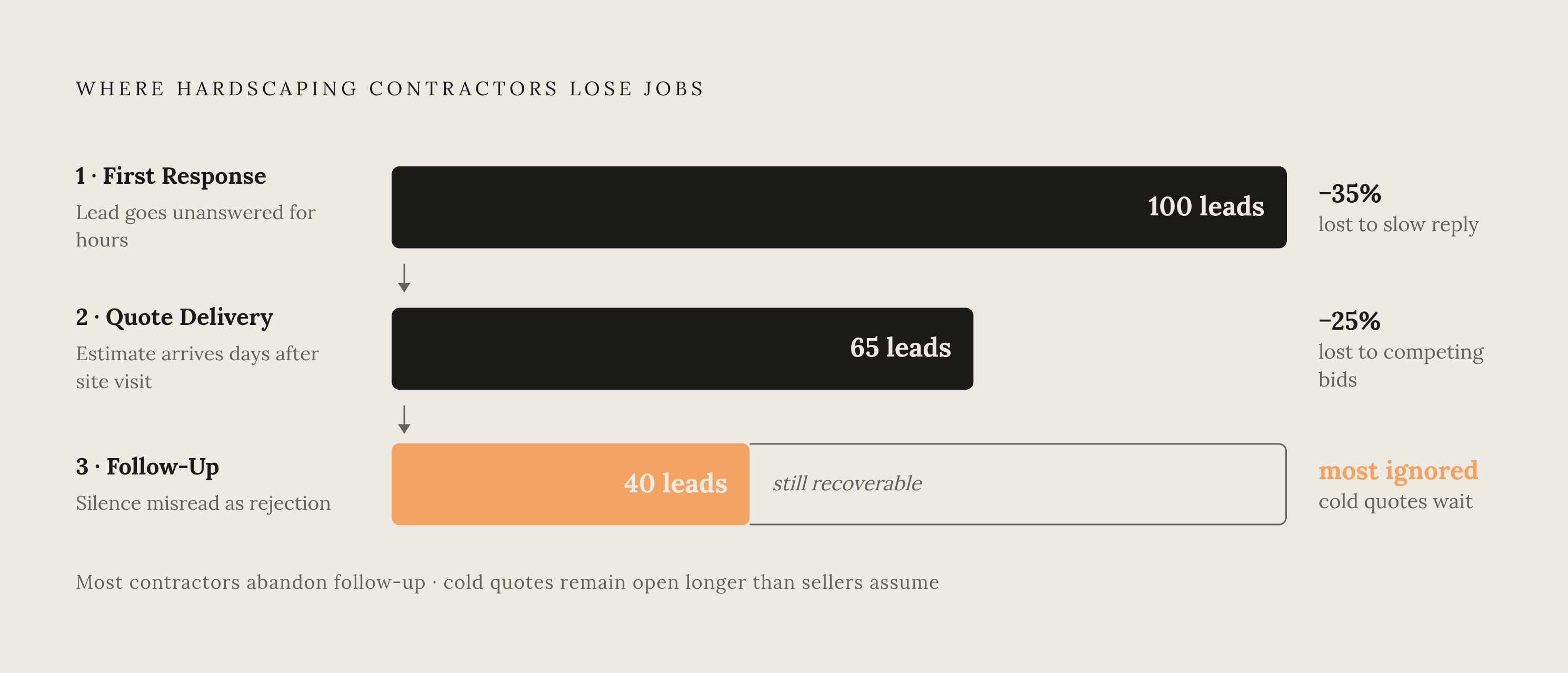
Contractors with a close rate problem are usually losing work at one of three specific stages: first response, quote delivery, or post-quote follow-up. Each stage has its own cause and its own fix. Treating "close rate" as one undifferentiated problem rarely leads anywhere useful.
The first stage is response speed. A lead comes in and sits unanswered for hours, or gets a callback the next day. By then the homeowner has often already reached another contractor. This stage is a speed problem, not a sales problem, and no amount of pitch refinement fixes it.
The second stage is quote delivery. A site visit happens, but the estimate takes days to arrive. By the time it lands in the homeowner's inbox, the urgency from the site visit has faded and competing bids may already be in hand.
The third stage, post-quote follow-up, is the one most contractors ignore. A meaningful share of quotes that go cold are still recoverable with a structured follow-up sequence. Businesses that don't follow up systematically are leaving signed work sitting in the pipeline, untouched. The quote has already gone out, the homeowner has gone quiet, and the silence gets read as a no when it often isn't one.
Outdoor projects run on longer decision cycles than most home services work, which raises the stakes at this third stage specifically. A homeowner who received a quote and went quiet may be comparing other bids, waiting on financing approval, or simply taking time to decide on a project that costs tens of thousands of dollars. A contractor who stops following up after a single attempt concedes those jobs by default, without ever learning whether they were actually lost.
Good, average, and weak close rates with the variables separated
Close rate benchmarks for hardscaping only become useful once they're stated separately by lead source, ticket tier, and sales stage. A blended number hides which of these three is underperforming. The ranges below are directional, useful for spotting where to look, not a scorecard for declaring a business healthy or broken off one figure.
By lead source, referrals and repeat customers are at the top of the range, reflecting the trust already built before the first conversation. Google Local Service Ad leads close at a meaningfully higher rate than paid social leads, consistent with the higher intent behind an active search. Facebook and Instagram leads close at the lowest rates in the mix, since the homeowner wasn't actively shopping when the ad appeared.
By ticket tier, small jobs like basic patios, walkways, and standalone features tend to close at higher rates. The scope is simpler, the financial commitment is lower, and the decision cycle is shorter. Large outdoor living projects, meaning full outdoor kitchens, poolscapes, and multi-element buildouts, close at lower rates as a matter of course. A contractor closing roughly a third to two-fifths of large projects is performing well, given the longer decision cycles, multiple competing bids, and financing considerations that come with that kind of spend.
By sales stage, a strong operation converts most qualified inquiries into a scheduled estimate. Losing the majority of leads before a quote ever goes out points to a response speed or qualification problem upstream, not a closing problem. From quote to close, the 20 to 40 percent range commonly cited across home services applies to hardscaping too, with one adjustment: the longer sales cycle means the measurement window matters. A job quoted in week one that closes in week six should still count toward that quote's outcome, rather than getting written off as lost before the homeowner has actually decided. On post-quote recovery, systematic follow-up recovers work that zero follow-up loses. Contractors running no follow-up sequence at all should treat their current post-quote close rate as artificially low, since it reflects an absence of effort more than an accurate read on demand.
Faster response and systematic follow-up moving close rates
The two process changes that move close rates most reliably for hardscaping contractors, answering faster and following up systematically, require no change to pricing, positioning, or sales skill. Both are matters of operational discipline, which makes them available to any contractor willing to build the system, regardless of how strong or weak their sales pitch already is.
Response speed comes first. Homeowners who don't reach a contractor on the first call tend to move on quickly, and most won't bother leaving a voicemail. The contractor who answers first holds a structural advantage before any sales conversation even begins. This pattern occurs across home services broadly, not as something unique to hardscaping.
Quote turnaround matters just as much. Delivering an estimate while the homeowner is still mentally engaged with the project, ideally the same day as the site visit, produces noticeably better close rates than sending it days later. The longer the gap between the visit and the quote, the more competing bids arrive in the meantime and the more the homeowner's initial enthusiasm cools off.
Post-quote follow-up closes the loop. A structured, multi-touch sequence on unconverted estimates recovers jobs that would otherwise go cold permanently. Contractors who treat silence after a quote as a final answer are underreporting their own close rate potential, because some share of those homeowners were never actually saying no. Given how long outdoor project decisions can take, follow-up sequences need to run longer than they would in a trade with a same-week decision cycle. A single follow-up call a week after the quote isn't enough for a homeowner who's still comparing bids or waiting on financing to clear.
Operationally, this is where automation does the heavy lifting. Voice agents that answer inbound calls around the clock, automated follow-up sequences tied to outstanding estimates, and CRM integrations that flag quotes gone cold are already in use across home services businesses, not some future capability waiting to arrive. None of these tools change what a contractor says to a homeowner. They make sure the right message reaches the right homeowner at the right moment, without relying on someone remembering to make a sixth follow-up call three weeks after a site visit.
Building a close rate tracking system that tells you where to improve
Every benchmark in this piece only works if a contractor can actually see their own numbers broken out the same way: by lead source, by ticket tier, and by sales stage. A close rate tracking system built around those three variables gives three times the diagnostic information of a single blended number, because each variable points to a different fix.
By lead source, tracking shows whether a weak overall number is really a paid social problem being dragged down by low-intent leads, or a referral problem that is far more alarming given how much trust those leads already carry. Tracking by ticket tier shows whether small jobs are propping up a close rate while large, high-margin projects are slipping away. Tracking by sales stage shows whether the leak is happening before the quote goes out, right after it's delivered, or in the weeks of silence that follow.
A blended close rate answers one question: what happened. A separated system answers the question that actually matters: where to fix it. A separated system turns a quarterly number a contractor glances at and forgets into a tool that tells them exactly which part of the business to work on this week.