Gross Margin Targets by Project Type in Hardscaping
Different hardscape project types carry vastly different cost structures and pricing power.

Hardscaping runs on meaningfully higher gross margins than general construction, and any contractor pricing jobs off a generic construction benchmark is building from the wrong floor entirely. A 2026 construction margin report shows specialty trades outperforming general contracting on both gross and net margin, and hardscape-class work, especially decorative and design-build installation, is in that same elevated band. Technical expertise is harder to replace, and licensing or skill barriers keep competition thin enough that specialty operators can hold pricing where general contractors cannot.
That gap matters because it changes what "good margin" even means for a hardscape business. A contractor benchmarking against general residential construction averages will chronically underprice jobs that should be commanding specialty-trade rates. The useful fix is a set of targets broken out by project type, because patios, retaining walls, and outdoor kitchens do not behave the same way financially, even though they all fall under the same trade category.
Gross margin range for hardscaping as a category
As a category, hardscaping benchmarks strong: gross margins run high enough that design-build installation work can push net margins past 20%. But it's also a number that hides more than it reveals, because maintenance work and installation work carry fundamentally different cost structures, and averaging them together produces a figure that doesn't actually tell an operator whether either side of the business is healthy.
The same logic that separates maintenance from installation applies again once installation itself gets broken apart. A paver patio, a retaining wall, and an outdoor kitchen all fall under "hardscape" on an invoice, but they draw on different labor intensity, different materials exposure, and wildly different scope uncertainty. A patio crew faces predictable site conditions and standardized material costs. A retaining wall crew faces soil variability and engineering requirements that can blow up a budget mid-job. An outdoor kitchen build involves design complexity and specialty components that neither of the other two categories touches. Blending all three into one hardscape margin target tells an owner almost nothing about where the business actually makes money and where it's bleeding it.
Once those categories get separated out, the numbers become something an operator can actually manage: a target for each type of job, instead of one average that smooths over the differences that matter most at bid time.
Gross margin targets for core hardscape project types: patios, walkways, and basic flatwork
Patios, walkways, and basic flatwork are the bread-and-butter jobs that fill most hardscape schedules, and they set the baseline every other project type gets measured against. Across the category, 2026 benchmarking data shows a wide average gross margin range, with high performers reaching 45 to 60%. Basic flatwork, standard concrete pours and simple paver installations, is toward the lower end of that band, because material costs eat up a larger share of the job and the work itself isn't differentiated enough to support premium pricing.
Decorative concrete and specialty paver work, stamped patterns, permeable paving, complex layouts, climbs above that floor, because it demands more skilled labor and faces less head-to-head price competition than a standard slab or a basic paver patio.
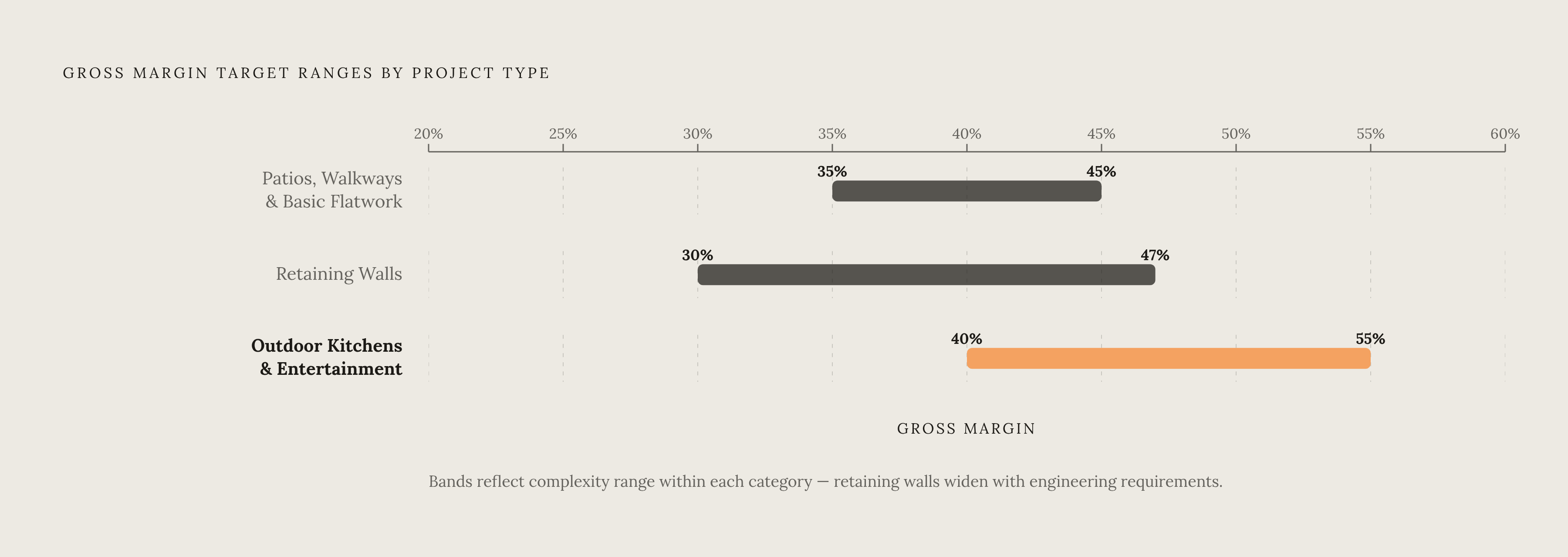
For well-run patio and walkway crews, the practical target is mid-to-upper thirties to mid-forties on gross margin, with net margin in a healthy double-digit range once overhead gets allocated. Crews that beat that range tend to do it by controlling material waste on standard jobs and pushing a larger share of their volume toward decorative or specialty paver work, where the margin ceiling is simply higher.
Gross margin targets for retaining walls and grading work
Retaining walls look like a harder version of patio work on the surface, but the cost structure is genuinely different because materials make up a larger share of the job and carry more engineering complexity. Materials costs make up a larger share of the total job and carry more engineering complexity than flatwork, which shapes the margin target differently.
Materials exposure is the biggest risk on these jobs. Block, stone, and drainage aggregate represent a bigger slice of total job cost on a retaining wall than on a patio, and those prices move with supply-chain conditions in ways that are hard to predict at bid time. Engineering requirements add a second layer of risk: footer depth, drainage systems, and tieback systems on taller walls all add labor hours that are easy to underestimate when a bid gets written, which makes detailed scope documentation a necessity rather than a nicety.
The concrete and foundations benchmark gives a reasonable reference point for walls carrying significant structural requirements, while decorative or terraced wall systems with less engineering exposure track closer to the patio range. Scope creep, unexpected soil conditions, buried utilities, drainage complications, is the single most common margin killer on these jobs. Contractors who build contingency into their bids and actually enforce change orders when conditions shift are the ones who protect their target margin instead of watching it evaporate mid-project.
Structural retaining walls with real engineering demands should target a lower-thirties to low-forties gross margin. Decorative terracing and lower-height garden walls, where engineering complexity is minimal, can run upper-thirties to upper-forties, closer to the patio range. The distinction that matters here is how much engineering and soil risk sits inside a given wall job, because that risk is what determines which end of the range a contractor should be pricing toward.
Gross margin targets for outdoor kitchens, fire features, and entertainment structures
Outdoor kitchens, fire features, and entertainment structures represent the highest-margin project category most hardscape contractors have access to, and the premium attached to this work is a function of the job itself, not simply a byproduct of bigger price tags.
High-performer hardscaping operators reach 45 to 60% gross margin overall, and outdoor kitchen and entertainment work tends to cluster at the top of that range. Second, the work itself is more differentiated: far fewer contractors can execute a full outdoor kitchen build, with gas lines, electrical, built-in appliances, and masonry all working together, than can pour a standard patio.
Materials markup contributes meaningfully to the premium as well. Industry pricing data shows hardscape material markups running in a meaningful range, and specialty components, built-in grills, stone veneer, pergola systems, often justify pricing at the upper end of that range. Put together, the practical target for this category runs low-to-mid forties to mid-fifties on gross margin, with net margin landing at the highest point in the hardscape category for contractors running lean overhead.
This is where project mix turns into a strategic lever rather than just a pricing exercise. A contractor who can shift a larger share of annual revenue into outdoor kitchens and entertainment structures raises the margin profile of the entire business without adding a single additional job to the schedule.
How the design-build model shifts margin targets
The project-type targets above assume a baseline business model, but the same patio, wall, or outdoor kitchen job carries a different margin target depending on whether the contractor designs the project or only installs it. A design-build firm and an install-only firm doing identical work carry different margin targets, and understanding this distinction lets contractors benchmark against the right peer group.
A design-build firm achieves 27 to 44% gross margins but carries meaningfully higher overhead to support that model. A design-only firm posts lower gross margins but carries much lower overhead in exchange. Install-only shops sit in a third position: lighter overhead than design-build, but they give up the design fee revenue that expands gross margin for firms that control the design process from the start. The real tradeoff is margin percentage against margin per hour of total business capacity, and the right answer depends on how a given shop is structured to operate.
Design fees matter here because of the extra revenue they represent. Landscape design pricing data shows design fees running a notable share of the total installation budget on residential projects, and that's revenue a design-build firm captures that an install-only firm simply never sees. Design-build also creates pricing leverage beyond the fee itself: a contractor who controls the design can spec materials and systems that support the margin target the business actually needs, rather than building to a plan some other designer already priced.
For contractors weighing the move into design-build, the overhead increase is a legitimate cost, not a minor adjustment. But the per-project revenue expansion, combined with the margin protection that comes from controlling the spec, tends to make the transition worthwhile once a contractor reaches sufficient job volume. The decision is about knowing which model a given business is actually running before comparing its margins to anyone else's benchmark.
The markup-versus-margin confusion that systematically undercuts these targets
Plenty of hardscape contractors are aiming at the right gross margin target and missing it anyway, because they're calculating it wrong. Markup and margin get treated as interchangeable terms on job sites constantly, and that confusion quietly undercuts every target described above.
The math is simple, and the consequence of getting it wrong is not. Markup gets calculated on cost; margin gets calculated on revenue. A contractor who adds a fixed percentage to their direct costs is not achieving that same percentage as a gross margin.
Run the numbers on a job with substantial direct costs. Marking that job up by a fixed percentage produces a higher sale price, sure, but the resulting gross margin falls well short of the markup rate used to get there. Most contractors don't catch the gap at the pricing stage. They catch it months later when net margin comes in soft, and by then the job is long closed and the shortfall is already baked into the year's numbers.
The damage compounds fastest on the largest tickets. On an outdoor kitchen or entertainment structure job, the dollar gap between a margin in the high twenties and one at forty percent is significant enough to meaningfully affect annual profit. It's a systematic error that appears across bids because contractors conflate markup with margin, and fixing that distinction is a prerequisite for hitting any of the targets laid out in this piece, regardless of project type.
What separates high-performing operators within each project type
Knowing the right target doesn't guarantee hitting it. The gap between an average hardscape contractor and a high performer in the same project category comes down to how the work gets run, priced, and controlled during execution, beyond which jobs land on the schedule.
Several operational habits separate the two groups consistently, as remodeling trade data and hardscape benchmarking both show.
- The most profitable hardscaping businesses post 35 to 50% margins by using technology for route optimization, dynamic pricing, and efficient scheduling, while operators still running on manual processes typically land well below that.
Scope documentation and change order discipline carry directly from remodeling trade data into hardscape work: the highest-margin operators document scope rigorously and price change orders consistently, which matters enormously because unexpected site conditions occur often on wall and grading jobs.
- Labor efficiency functions as the primary lever most contractors underuse. Untracked non-billable time, drive time, equipment loading, inefficient routing, accumulates week over week across a season, and it reduces net margin directly. Contractors who measure that time can manage it; the ones who don't absorb the loss without ever seeing where it came from.
- Flat-rate pricing protects margin more reliably than time-and-materials billing. It speeds up the sales conversation, reduces variance between crews, and makes coaching performance against a target far simpler than billing hour by hour.
- Response speed on inbound leads functions as a genuine margin lever. Businesses that respond to new leads within the hour are more likely to stay fully booked, and a fully booked schedule gives a contractor the pricing power to hold the target margin instead of discounting work just to fill the calendar.
The margin targets described throughout this piece, mid-to-upper thirties for patios, lower-thirties to upper-forties for walls depending on engineering complexity, low-forties to mid-fifties for outdoor kitchens, are achievable benchmarks, not theoretical ceilings. Operators who bring the same rigor to scope documentation, labor tracking, pricing structure, and lead response that they bring to the installation itself are the ones who consistently land at the top of each range rather than somewhere in the middle of it.
Sources
- Construction Profit Margins by Trade (2026)
- How to Price Landscape Design Projects: The Complete 2026 Guide for Professionals
- Landscaping Business Profit Margins: Know Your Numbers, Keep More of What You Earn
- Landscaping Profit Margins: 2026 Benchmarks
- Blue Collar Strong: The 2026 Home Service Trends Report