Tiered Pricing Architecture for Hardscape and Remodeling Contractors
Offering three complete project options instead of haggling over one price.

A single-number quote gives a homeowner one decision: yes or no. Tiered pricing swaps that for a different question: which version of this project fits their life. That shift, from a binary to a choice among options, is what separates contractors who end up haggling over price from ones who steer the conversation toward scope. Most contractors still build quotes the first way, and that habit is costing them margin they'll never see.
What tiered pricing architecture is, and what it is not
Tiered pricing is a good/better/best presentation of scope, built at three price points. It is not a discount ladder where the cheap version is a stripped-down copy of the "real" quote. Each tier has to stand on its own as a complete, coherent project, one a contractor would build exactly as described, at any level, without wincing at the result.
Tiers get confused with two other things, and the mix-up costs real money. Add-ons happen after the contract is signed, when a homeowner decides mid-project to squeeze in a fire pit. Change orders are reactive, appearing when scope creep hits the job site. Tiers are neither. They get set before anything gets signed, offered at the proposal stage, before a shovel touches dirt. Treating tiers like an add-on menu or a change-order buffer collapses the whole structure back into a single-number quote with extra steps.
The real payoff is a shift in relationship. A contractor handing over three options isn't quoting a job anymore, they're advising on a design decision. That's a different conversation entirely from the one built around a single number that either gets accepted or picked apart line by line.
Anchoring drives most of it. Setting a premium tier next to the middle option makes the middle option start looking reasonable by comparison, sometimes even modest. The homeowner stops comparing the contractor's number against a competitor's number and starts comparing packages against each other. That pattern holds with enough consistency that it is really not up for debate: 60 to 70% of buyers choose the middle option, 20 to 30% go premium, and only 10 to 20% pick entry (per ProScapeAI's pricing guide). Anchoring does most of the work in that room, full stop.
How hardscape project value distributes across tiers
Published pricing data gives a reasonable starting map for where tier boundaries should sit before any local adjustment gets made.
At the entry level, a basic patio or walkway refresh (concrete pavers, minimal structure work) sits at the lower end of installed hardscape pricing. The mid-tier covers a full paver patio with a proper base and some modest softscape, running roughly $8,500 to $27,000 installed, averaging $17,750 (per Techo-Bloc's national contractor survey). Premium tier layers on structure: a pergola, retaining walls, a fire feature, maybe an outdoor kitchen, stacked onto the full hardscape and softscape package. At the top end, projects with a pool, a full outdoor kitchen, or architectural stonework average around $55,000 (per Techo-Bloc's first-party data).
Per-square-foot numbers work as a cross-check against those totals: paver patios run $15 to $40 per square foot, retaining walls (by face area) run $25 to $60, and natural stone patios or walkways run $30 to $70 (per SimplyWise).
These figures are starting points, not fixed rules, and local market conditions swing them hard. Tier boundaries should follow real cost inflection points, not arbitrary 20% jumps stacked on a spreadsheet. Base depth, drainage work, added structures, material grade: those are the actual walls between tiers. Build pricing around them, not around a formula that tacks a flat percentage onto each level and calls it a system.
Adjusting tier ceilings for your market before setting prices
None of the numbers above transfer cleanly across state lines, and treating them like they do is where a lot of contractors underprice their own work. Labor makes up 40 to 60% of most hardscape project costs (per ProScapeAI), and labor rates swing by geography more than almost any other input in the job. The same spec, same materials, same square footage, can run 50 to 80% higher or lower depending on where the crew happens to be standing.
Metro markets in major coastal cities run 30 to 40% above average landscape design rates. Rural markets sit 20 to 30% below (per ProScapeAI). The national median hourly wage for landscaping and grounds workers is $18.82 (per O*NET/BLS data), and that median buries a lot of range: a six-metro comparison puts Boston at the top of the wage scale, with Dallas landing close to the national median.
On the ground, that means a mid-tier project in coastal California can carry the same price tag as a premium-tier project in rural Appalachia. Treating the two markets the same makes a contractor either scare off buyers or leave money sitting on the table. Tier labels need to track local purchasing power. Material costs matter too, though they move less than labor does. Plants typically run 2 to 3.5 times over wholesale cost (per ProScapeAI).
For a contractor unsure whether current pricing sits too low, the fix isn't a guess, it's a test: raise rates 15 to 25% for the next three to five new clients and watch conversion. If it holds above 50%, the market will bear the new number, and it's time to roll the increase out across the book (per ProScapeAI).
Building each tier so it earns its place on the page
Each tier has one job. Confuse those jobs and the structure quietly falls apart from the inside.
The entry tier exists to anchor, not to generate revenue. Contractors who try to make it profitable on its own usually undercut the whole structure, because they start stripping scope until the number works, which is exactly the wrong direction. It should still turn a profit, but nobody should be optimizing around it. Functional scope, standard materials, no added structures: the minimum version a contractor is still proud to put a name on.
The middle tier exists to close. This is the project a contractor would build if a homeowner handed over full trust and a reasonable budget. Building it well means a real scope jump from entry, not a small tweak, something like a pattern upgrade, an edge detail, or a drainage feature the homeowner can point to and actually understand. Every improvement in the middle tier needs a name attached to it, because homeowners should know what they're getting for the extra money instead of accepting a bigger number on faith. The middle tier should also sit close enough to premium that stepping up feels like a natural extension rather than a financial leap.
The premium tier exists to anchor from above and to catch the homeowners chasing the full vision. Even when it doesn't close, it pulls interest toward the middle. Build it with structural upgrades (pergola, outdoor kitchen, retaining wall), finish upgrades (premium stone, a custom pattern), or scope extensions (full softscape, irrigation).
Every tier needs one line explaining why it exists that isn't a spec list. Skip "12-inch base, polymeric sand, 3-inch pavers" in favor of a sentence about what life looks like once the project is finished. Outcome-focused language earns its place exactly here, because homeowners buy an outcome before they buy a spec sheet.
Building three price bands first, then stuffing scope into them until they hit a target number, gets the sequence backwards. The work should decide the price. Contractors who do it the other way end up defending numbers they can't actually explain.
Sequencing the presentation so homeowners move toward scope rather than away from it
Order matters as much as content, and most contractors get it wrong by leading with the cheapest option out of some misplaced instinct toward modesty. Lead with premium instead. Showing the top tier first anchors the homeowner's sense of scale before they've built a reference point for what "expensive" even means on this particular project.
Walk through every tier out loud before handing over any document. A PDF left on a kitchen counter doesn't argue for itself; a contractor does. Names carry weight too: "Foundation," "Retreat," "Full Vision" lands differently than "Basic," "Standard," "Premium." One set of names describes a feeling. The other describes a discount.
One question does more work than almost anything else in this conversation: "If budget weren't the constraint, which of these feels most like what you were imagining?" That question puts the aspirational tier on the table before any negotiating starts, and it gets the homeowner talking about what they want instead of what they're willing to spend.
When someone gravitates toward the entry tier, resist folding immediately. Ask what they'd add if money weren't the issue. That question usually raises the exact upgrade that becomes the scope bump, the thing they wanted all along but assumed they weren't allowed to ask for.
Field service data on proposals with optional line items shows upsell rates between 25 and 50%. Tiered presentation is what makes those options visible before a contract gets signed, instead of after, when the only path to more scope runs through a change order.
Timing carries its own weight. A proposal walked through in person, standing in the actual yard, closes faster than one emailed cold, because the homeowner can picture the finished space while the numbers are still on the table in front of them. Renderings, material samples, and portfolio photos tied to each tier do similar work: they strip the abstraction out of the middle and premium tiers and make them feel like something that could exist in that yard next month.
Where Financing Turns a Tier Conversation Into a Signed Contract
Most of the time, the gap between the tier a homeowner wants and the tier they choose has nothing to do with value. It comes down to cash flow, plain and simple.
Financing changes the question from "how much does this cost?" to "how much does this cost per month?" That's a question most homeowners already know how to answer, because it's the same question they've answered for a car or a mortgage.
Timing matters here too. Introduce financing at the proposal stage, alongside the tiers, not afterward as a rescue attempt once someone balks at the number. Presented early, financing becomes a built-in feature of the mid and premium tiers. Presented late, it reads as a consolation prize, and homeowners can tell the difference.
Programs like Techo-Bloc's Pave Now, Pay Later, available nationally, let homeowners move forward on outdoor kitchens, patios, and fire pits without paying the full amount up front (per Techo-Bloc's contractor guidance). Partnering with a lending option like this repositions the contractor as a full-service provider solving the whole problem, construction included. That matters because homeowners who might otherwise collect three competing bids to chase the lowest number often stop shopping the moment financing removes the lump-sum obstacle.
Financing estimates belong on the proposal document itself, a monthly figure sitting right next to each tier, not something mentioned verbally in passing and forgotten by the time the homeowner is back at their kitchen table. Most homeowners have already emotionally committed to the outcome before the quote arrives; financing is what turns that desire into a signature.
Operational Effects of Tiered Pricing at Scale
Tiered pricing only keeps its margin advantage if it runs on templates. Contractors who rebuild scope and pricing from scratch on every job lose most of what the framework was supposed to give them, and they usually don't notice until busy season exposes it.
A connected quoting system with pre-built tier templates cuts the time between a site visit and a finished proposal dramatically, with research on AI-assisted estimate creation citing significant reductions in time per proposal. That speed matters for a concrete reason: homeowners who get a proposal within hours of the site visit are far more likely to sign at the scope presented. A proposal that takes a week invites comparison shopping and hands the homeowner time to talk themselves down to a smaller version of the project.
Standardized templates also enforce pricing discipline. Markup standards, including the 2 to 3.5 times wholesale mark on plants, get baked into the system instead of getting re-negotiated under pressure at the kitchen table. Optional line items built into the template appear consistently on every proposal, which is the only way that 25 to 50% upsell rate actually holds across a full book of work. If the add-on prompt only appears sometimes, the upsell only happens sometimes.
Reviews compound the effect from outside the sales conversation. Research consistently shows that a strong majority of consumers read online reviews before hiring a contractor. A contractor known for sharp, professional proposals starts every new conversation from a position of trust, and trust is what lets a contractor hold a price instead of negotiating it down before the ink dries.
Fragmented tools work against all of this. A separate CRM, a separate estimating tool, a separate follow-up system: every gap between them is a place where a homeowner goes cold between the site visit and the signed contract, reintroducing the exact delay tiered pricing was built to remove.
Measuring whether your tier structure is working, and the signals that say to adjust it
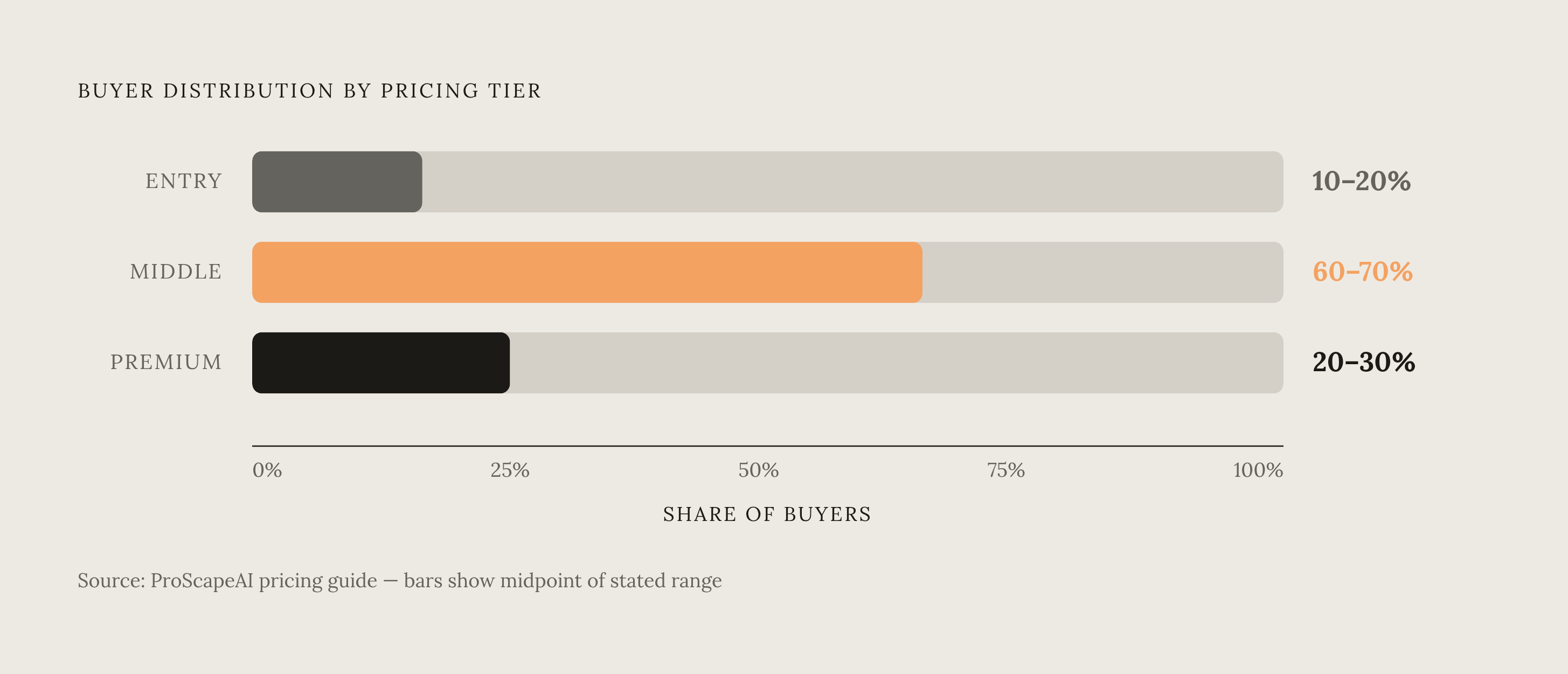
60 to 70% of jobs should close on the middle tier, 20 to 30% on premium, 10 to 20% on entry (per ProScapeAI's guide). If a contractor's numbers look inverted from that, something in the structure needs fixing, and guessing at what usually wastes more time than diagnosing it directly.
A few signals point to specific problems. Heavy entry-tier concentration usually means the middle and premium tiers are priced above what the market will bear, or the value story attached to the middle tier isn't landing when it gets presented out loud. Almost nobody choosing premium usually means it isn't differentiated enough from the middle option, or it isn't being shown first the way the sequencing above suggests it should be. A high share of proposals ending in "none of these" points somewhere else entirely: the entry tier might be priced too high, or the real problem sits earlier in the funnel, in lead quality, in trust, in how slowly the proposal arrived after the site visit.
The same diagnostic logic applies to tier thresholds: adjust the boundary, watch the next handful of clients, and let conversion data decide whether the new threshold holds.
Tracking which tier each closed job came from, then comparing average job value against target margin, turns pricing into something measurable instead of something felt. Revenue should concentrate in the middle and premium tiers, since that's where the actual margin lives, and any structure that doesn't push volume there needs rework, not patience.
Seasonality plays its own role. Techo-Bloc's report found that spending has grown more intentional overall, with many homeowners prioritizing improvements that protect property value or reduce environmental risk, while higher-income segments keep investing in lifestyle-driven outdoor spaces regardless. Premium tier close rates tend to track that pattern alongside overall project volume.
None of this gets set once and left alone. Update it when material costs shift, when local labor rates move, or when a new project type, an outdoor kitchen, permeable hardscape, a wellness garden, occurs often enough to earn its own line in the structure. A contractor who tracks tier distribution over time is running something close to a pricing intelligence system in the background, where every proposal becomes a data point instead of just a bid, showing whether the positioning needs work, the presentation needs work, or the scope itself needs to change.