Subcontractor vs Employee Mix at Different Revenue Stages
Shift your workforce mix at revenue thresholds, not personality preferences.

The right mix of subcontractors and employees moves with revenue, and it shifts at specific, predictable points as a contracting business grows. Most contractors treat the call as a matter of personality: "I like flexibility," or "I want control over my crew." Those are excuses for not tracking the number that actually decides it.
Workforce mix is a lever, not a belief system. Lean on subs past the point where the business can support employees, and quality gets inconsistent, jobs go sideways, and a reputation built over years takes a hit from a single bad review. Hire W-2 employees too early, and fixed payroll appears in the bank account whether the phone rings or not, squeezing margin before revenue can carry the weight. Calling someone a subcontractor when the law says employee means that mistake compounds with every dollar of revenue added to the roster.
None of this holds still. It moves at predictable moments, and the contractors who see those moments coming keep more margin than the ones who guess their way through it.
Subcontractor and Employee Costs and Provisions Beyond the Surface-Level Comparison
Subcontractors get paid when there's work and not a day before. No slow-week payroll drag, no employer-side payroll taxes, no workers' comp premium, no benefits line item. They show up with their own trucks and tools, so the business never puts up capital for that. They set their own rates and run their own schedule. In exchange, the business buys output, not hours.
That distinction carries more weight than it sounds. If a contractor tells a "sub" how to do the work, when to show up, and where to park the truck, the classification is shaky no matter what the contract says. The law looks at behavior, not paperwork, and this is the exact fact pattern that turns a sub into a misclassified employee.
Employees flip nearly every part of that equation. Payroll runs whether the crew has three jobs that week or none. The business supplies the tools, the vehicle, the training, and carries tax withholding, benefits, workers' comp, and overtime. What comes back is control over how the work gets done, a consistent brand at the customer's door, and skill that compounds because the same person keeps doing the same job week after week.
Revenue per employee, total revenue divided by total full-time equivalents, is the cleanest read on whether headcount earns its keep. Subs paid for completed jobs don't get counted, since the business buys their output rather than employing their labor. Remodelers and general contractors run at meaningfully higher sub ratios than pure employee-driven shops like HVAC or cleaning, and that gap resets what "normal" looks like at every stage that follows.
Stage one: sub-$350K revenue, where subcontractors carry the overflow
The owner is usually still on the tools here, doing a good chunk of the work personally. Subs exist to catch overflow, not to run the core of the business, and any contractor who forgets that distinction is setting up a quality problem before revenue even justifies the risk.
Take a plumbing outfit in its first two years, revenue between $180,000 and $350,000, running two subcontractors for overflow work. Each brings a truck and tools, each works other clients on the side, each gets paid per job. Financially, it works. No fixed labor cost sits on the books during the slow stretches.
The problem appears in quality instead. Work gets inconsistent, and because the sub's name isn't on the invoice, the contractor's name is, so the inconsistency becomes the business's problem. A sub-par install with the wrong name attached still damages the wrong reputation.
The pattern makes sense at this stage anyway. Revenue is too unpredictable to justify fixed payroll, and job volume doesn't come close to filling a full-time technician's week. Subcontracting bridges the gap fast when the owner starts winning more work than one person can physically handle. But the brand is fragile here, and reviews are thin: one bad sub job doesn't just cost a callback, it can define how the business gets talked about for a year.
Stage two: $350K–$700K revenue, where the first W-2 hire changes the math
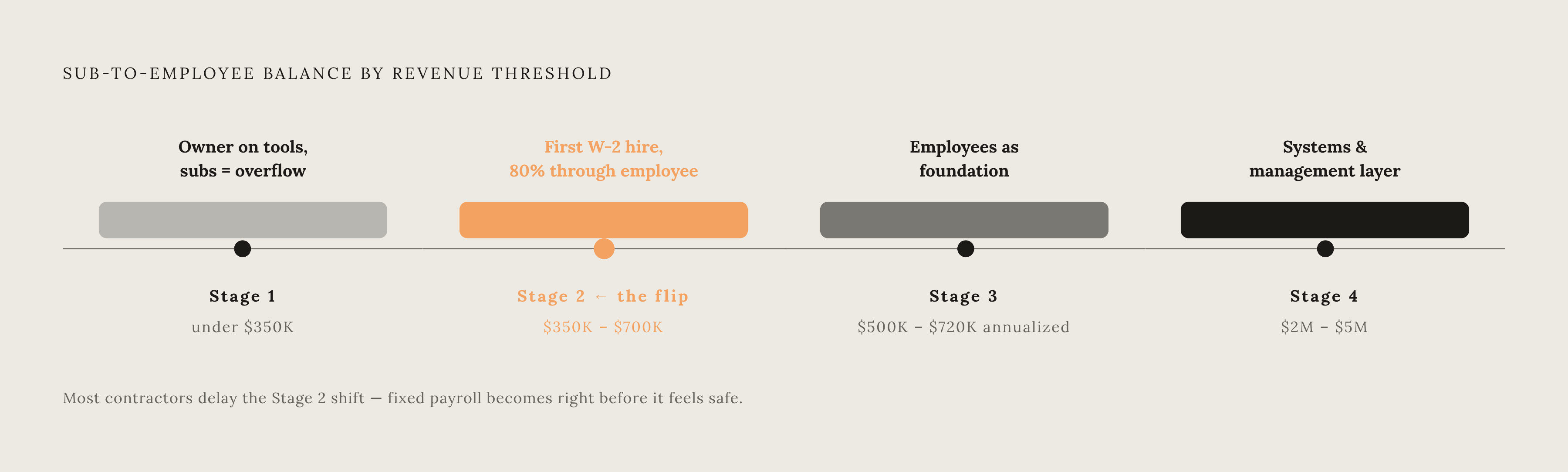
Same plumbing business, years three and four, revenue in the $450,000 to $700,000 range. The owner brings on the first full-time W-2 technician, and almost immediately 80% of the work routes through that employee instead of through subs.
The fully-loaded cost of an employee runs higher than a per-job sub payment, no question. But the trade-off tips clearly in the employee's favor now: higher fixed cost, yes, but higher output value and far more consistency, and the revenue finally supports carrying it.
This is the stage where the math flips. Enough recurring volume exists to keep one W-2 technician busy most weeks of the year, and the owner can finally step back from the tools, or at minimum stop being the only person checking quality on every job. Subs get pushed back to genuine overflow and specialty work instead of carrying the core of service delivery.
Remodelers should read this stage differently. Remodelers are benchmarked at close to a 2:1 sub-to-employee ratio and can sustain that, well above what a pure service trade like plumbing would typically run. Even so, the employee anchor matters: someone has to own quality control and carry the brand on-site, even when the ratio skews more toward subs.
A useful trigger for this hire: once job volume consistently keeps a technician occupied most weeks, and the revenue forecast can carry payroll through at least one slow month, the hire is defensible. Wait longer than that, and the owner just keeps absorbing the workload personally while subs quietly run the business's reputation.
Stage three: $40K–$60K, where employees become the foundation
Once monthly output is in the $40,000 to $60,000 range, most of the regular, recurring work should be staffed by employees, not subs. Subs still have a place: overflow, specialty skills, geographic reach. But they shouldn't be the backbone of how jobs get delivered anymore, and a business still leaning on them that heavily at this size is running behind its own growth.
The economics flip for a straightforward reason. Revenue is predictable enough now that fixed payroll doesn't squeeze margin the way it would have two stages earlier. Reputation has also become a real, protectable asset rather than a fragile one, and that asset depends on a consistent crew doing consistent work. Clients at this tier tend to be higher-value homeowners or commercial accounts, and they expect the same faces on repeat visits.
Used correctly at this stage, subs handle specialized trade work the core crew doesn't do (electrical or drainage engineering, for a hardscape contractor). They cover geographic overflow when a job lands outside the normal service radius, and they absorb seasonal demand spikes without forcing the business to carry headcount it doesn't need in the off months.
If revenue per employee falls short of the trade benchmark here, adding more subs is not the fix. Job values may run too low, headcount may have outpaced demand, or the existing crew simply isn't scheduled efficiently.
Stage four: $2M–$5M, where the wall hits and workforce structure is usually the reason
Operators tend to hit a wall somewhere around $3 million to $5 million, and it's rarely a demand problem. The owner is maxed out, the technicians are maxed out, and the back office is maxed out.
The workforce issue looks the same across trades at this stage. The owner still functions as de facto production manager, quality inspector, and estimator, with no middle layer of management to absorb any of it. The sub network, built on relationships rather than systems, doesn't flex on demand, so one key sub goes unavailable and a job is suddenly at risk. Meanwhile the employee roster has grown, but scheduling, dispatch, and job hand-offs still happen by hand, with nothing coordinating any of it.
A $2 million home service business can usually grow another 20% to 30% just by tightening existing operations. Past that, growth needs capital, more hires, better systems, and outside expertise brought in on purpose. Fiddling with workforce mix at the margins won't move the number.
Some operators have broken through this wall by fixing exactly that. Jorge B. in Florida grew Prime AC & Heat to multi-million-dollar revenue with 9 employees and 7 vans. Jay V. in Texas scaled Frontier Air Conditioning several times over with a team of more than 20, built on customer retention and a branded membership program. Will H. took A-1 Cleaning from a one-person operation to a 45-plus person team, with more than 690 Google reviews and a 4.9-star rating. Brett C. scaled Chimney Monkey to $2 million through disciplined operational choices.
Benchmark Interpretation for Remodelers and Hardscape Contractors
Remodelers, as a category, generate more revenue per project while running a sub-to-employee ratio close to 2:1. General contractors run around 1.5:1. Both numbers sit well above what an HVAC or cleaning business would tolerate at the same revenue level, and there's a real operational reason for that gap, not just industry habit.
Project work is episodic. A patio installation doesn't need the same crew back every week the way a maintenance contract does. Specialized work (masonry, drainage, lighting) gets legitimately subcontracted because no single crew realistically carries every one of those skills in-house, and job values run high enough that the margin math still works even with a heavier sub share.
The risk doesn't shrink to match, though. The homeowner segment driving most hardscape work (the practical backyard upgrader, the retired couple investing in quality of life, the owner finishing out a legacy home) typically spends $5,000 to $18,000 or more on a project. That buyer expects one accountable party, not a patchwork of subs pointing fingers at each other if something goes wrong.
So hardscape contractors can run a higher sub ratio than a plumbing or HVAC benchmark would suggest. But the person whose name is actually on the job, the one the client remembers and refers or complains about, still needs to be a W-2 employee standing on-site. Classification on paper doesn't change who the customer blames.
The misclassification trap that grows with revenue
Misclassifying a worker is a legal and financial exposure that grows right alongside headcount and revenue. The test courts and agencies apply is behavioral: if the business controls how the work gets done, when it happens, and where, the worker is likely an employee under the law, regardless of what any signed agreement says.
Risk scales in stages. Below $350,000 in revenue, exposure runs lower, since the business is still small and workforce relationships are simpler. Between $350,000 and $700,000, exposure climbs: this is the stage where the business is growing quickly and workforce roles tend to blur, which is when misclassification can happen without intent. Past $700,000, the exposure turns into real money: misclassification consequences compound alongside the larger payroll and revenue base.
Timing that first W-2 hire correctly is a risk-management decision as much as a staffing one. Treating it that way keeps a contractor out of a mess that only gets more expensive to clean up the longer it sits.
Operational Systems and the Optimal Mix
At almost every stage, the real constraint isn't the cost of labor. It's whether the owner has the bandwidth to coordinate it.
A sub-heavy model without systems behind it gets harder to run with every sub added. Checking availability, untangling scheduling conflicts, following up on quality, reconciling invoices: all of it multiplies. An employee-heavy model fails the opposite way. Without efficient scheduling, idle employees are still paid employees, and that's margin walking out the door regardless of how the org chart looks on paper.
The ability to sustain a workforce mix at all, sub-heavy or employee-heavy, tracks closely with whether the systems behind it can actually keep up. Get the systems right, and the ratio mostly takes care of itself. Get them wrong, and no ratio, however carefully benchmarked, saves the business from itself.