Seasonal Revenue Smoothing Strategies for Outdoor Remodeling Contractors
Plan projects three months ahead to fill peak seasons before demand spikes.

Outdoor remodeling runs on a calendar, and the contractors who fight that fact spend every winter wondering where the leads went. Spring and summer are execution windows, weather shuts down exterior work for months at a time, and homeowners plan projects around the seasons no matter what a contractor's marketing budget says. Calling that "feast or famine" gets the framing backward. A cycle you can see coming a year in advance is a planning problem, not a market failure, and planning problems have fixes.
Contractors who wait for the phone to slow down before they act pay for that delay twice: once in idle crews, then again in the premium it costs to restart demand on short notice. Panic-driven lead pushes in a dead month routinely blow past the customer acquisition costs home services businesses plan for. Treating slow months as structural instead of accidental changes how a business plans its entire year. That shift is the foundation for everything below.
What the 2025–2026 demand environment looks like for outdoor remodeling
The category is growing, just not fast. Remodeling and repair spending is on track for roughly 1.2% growth through the second quarter of 2026, softer than recent cycles. That kind of growth won't cover for a broken pipeline, and the field has gotten a lot more crowded to compete in: the country had about 69,000 remodeling firms in 2000, and by the start of 2025 that number had climbed to 128,000. More competitors chasing slower growth means pipeline discipline now decides who stays booked, in a market where a firm used to coast just because there were fewer options to pick from.
Contractor sentiment is still upbeat, oddly enough, and that optimism is worth being skeptical of. Seventy-seven percent of residential remodeling contractors say they're optimistic about the 2026 market, and 72% are raising rates. But only 18% point to rising demand as the reason for those price increases. Most rate hikes are defensive: margin protection against rising costs, not proof that customers are lining up. That distinction should kill the assumption that demand will bail out a weak pipeline. It won't, because most rate hikes are defensive moves to protect margin, not proof that customers are lining up.
Homeowners are still engaged, just more careful about what they commit to. Project planning is at a five-quarter high, but spending expectations stay cautious, and maintenance work and smaller refreshes are outpacing big discretionary remodels. Homeowners planning 2026 projects expect to spend around $7,117 on average, a number that works as a gut check on which project types actually pencil out right now. A survey from Eagle Woodworking backs this up: bathroom remodels and general repair and maintenance work lead the pack, while full gut renovations have gotten rarer. Homeowners want phased, high-impact upgrades, not moonshots. For contractors, that means the calendar has to get filled by design. Nobody's rising tide is doing it for them.
How homeowner intent shifts by season
Homeowners don't think about their homes the same way in March as they do in October. Their emotional state, their sense of urgency, even which problem feels most pressing, all shift with the calendar. Messaging that ignores that timing is messaging aimed at nobody in particular.
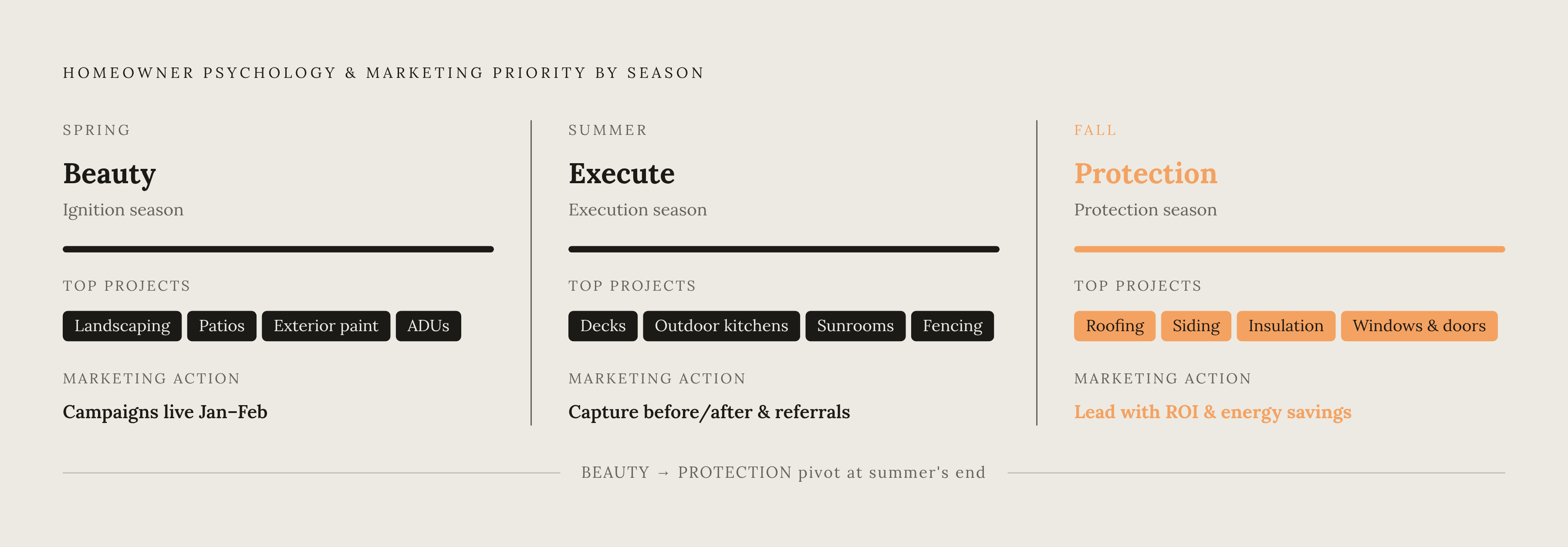
Spring is ignition season. Homeowners come out of winter wanting curb appeal fixed and outdoor living spaces ready for use, and they move fast from browsing to booking. Landscaping, exterior painting, patios, kitchen and bath upgrades, and ADUs all spike here. Spring demand gets won months before spring arrives, so campaigns need to be live in January and February, before every competitor in the metro area floods the same search terms and social feeds. Wait until March to start marketing spring work, and the calendar's already claimed by someone else.
Summer is execution season, and it's also a trap. Revenue peaks here, crews run flat out, and that's why forward-looking marketing quietly stops. Nobody's writing blog posts or chasing reviews while running four job sites at once. But summer is precisely when the material for fall and winter campaigns needs to get made: before-and-after photos, referral asks, review requests. Outdoor kitchens, decks, major kitchen remodels, sunrooms, and fencing dominate the project mix here. Skipping the documentation now means there's nothing to market with come October.
Fall flips the psychology. Homeowners stop thinking about beauty and start thinking about protection, and "before winter hits" becomes a real motivator instead of a marketing line. Exterior and envelope categories, siding, roofing, insulation, naturally come to the foreground as homeowners shift focus toward protection before winter. Weatherproofing, drainage fixes, door and window replacement, and energy upgrades lead the project mix. Messaging built around ROI and energy savings beats anything aesthetic in this window, because the homeowner isn't dreaming about a patio anymore. They're worried about a pipe freezing.
Building a pipeline timing system so peak-season work is already sold before it starts
By the time spring demand appears in a demand-tracking tool, in foot traffic, in the number of quote requests, the contractors who planned ahead have already claimed the calendar. Reactive pipeline management just means chasing leads other contractors already booked three months earlier.
Lead time decides who wins that race. Rank Contractors' 2026 guide recommends starting off-season campaigns three to four months before the season actually opens, and the same logic applies directly to booking peak-season capacity. Landscaping work, much like HVAC and electrical work, tends to run a 30 to 90 day sales cycle from first contact to signed contract. Starting those conversations in January means March and April slots fill on schedule instead of getting scrambled together in real time.
Early-bird offers turn that lead time into committed revenue instead of just warm interest. One documented approach: build an "Early Bird Spring Project" list, offer an incentive for locking in a project before the season opens, and promote it through email and social ads through January and February. That produces actual bookings, not just names on a list, and it kills the anxiety of staring at an empty March calendar in February.
Retargeting closes the loop on everyone who almost converted. Homeowners who visited a website in fall or winter but didn't pull the trigger are still warm, and staying visible to them through retargeting keeps a contractor top of mind through the whole decision window. Competition for ad space drops in the off-season too, so that spend usually costs less per click than the same audience during peak months. That makes off-season retargeting one of the more efficient dollars a contractor spends all year.
Marketing channels that move the needle at each point in the seasonal cycle
Digital discovery isn't optional anymore. The vast majority of consumers use the internet to find local businesses, so a contractor without a real digital presence is invisible to nearly everyone shopping, regardless of season. A representative budget split for home services digital spend typically anchors Google Ads at 35 to 40% and Google Local Services Ads at 15 to 20%, with the remaining share distributed across social, SEO, email, and partnerships based on market and season.
That split shouldn't stay fixed all year, though, and treating it as fixed is where a lot of budgets go to waste. During spring and summer, Google Ads and Local Services Ads earn their keep by catching homeowners who are actively searching and ready to decide fast, so paid search claims the biggest share of budget during peak months. During fall and winter, SEO content, email nurture campaigns, and retargeting carry more of the weight, since competition is thinner and consideration windows run longer. The content published now builds the authority spring campaigns lean on later. Email and social work well for time-boxed pushes, like promoting tax-season upgrades or early-bird programs in January and February, because the contractor controls the timing on those channels instead of an algorithm deciding who sees what.
Cost follows the same rhythm. Competitive metro markets push cost-per-click well above national averages during peak season, and that same audience often costs less to reach in the off-season. Category matters too: hardscape and outdoor living work is in the mid-range of cost-per-lead benchmarks, while roofing costs at the expensive end of the spectrum. Where a service category lands on that scale should shape how a seasonal budget gets built from the start, not get bolted on as an afterthought once the numbers are already set.
None of this locks in place once and stays there. An annual marketing calendar should tell a contractor exactly when to shift weight from one channel to another, month by month, and that calendar is the operational backbone of everything in this section. Rank Contractors warns that relying only on peak-season demand, without a mix of lead sources feeding the pipeline year-round, causes the feast-or-famine pattern.
How recurring service agreements and maintenance plans flatten revenue between projects
Outdoor remodeling is lumpy by nature: big tickets, long gaps between touchpoints, and months where a customer who paid a substantial sum in July has no reason to think about the contractor again until the next big project comes up. Recurring service agreements exist to close that gap.
Companies using AI-assisted follow-up now see recurring contract attach rates of 25 to 40%, up from 10 to 15% before AI took over the follow-up grind. That range gives a contractor a real target to aim for. Recurring revenue exists to raise the floor so a slow month doesn't feel like free fall, not to replace project work. It's there to raise the floor so a slow month doesn't feel like free fall.
In outdoor remodeling specifically, that means building maintenance packages around the seasons themselves: drainage inspections before winter, hardscape sealing, lighting checks, outdoor kitchen prep before summer entertaining season. Fall energy efficiency and weatherproofing packages act as a natural bridge, carrying a customer from "the deck's finished" in August into "let's talk about winterizing" in October, without a hard stop in between. Preventative maintenance and energy efficiency upgrades are the off-season work that fills the gap between big installs.
Maintenance plans do more than smooth revenue, though. They keep a contractor in a homeowner's life on a regular rhythm, and that matters because the competitor who shows up in a Google search six months later doesn't stand a chance against the one who's already been on-site twice. A homeowner who's happy with a maintenance relationship refers new business at a far higher rate than someone who worked with a contractor exactly once and never heard from them again.
Where AI tools create leverage in seasonal lead handling, follow-up, and booking
Slow seasons and peak seasons create the same problem from opposite directions. In a slow month, fewer staff are on hand and urgency drops, so the leads that do trickle in get slow responses. In peak season, call volume overwhelms whoever's answering the phone, and the result is the same missed opportunity, just for a different reason.
Speed matters either way, and the numbers make that hard to argue with. Service businesses miss somewhere between 60 and 80% of inbound calls during business hours, and each missed call represents somewhere between $200 and $2,000 in lost revenue depending on job size. AI receptionist systems recover roughly 28 to 30% of those otherwise-lost leads simply by answering every call instead of letting it roll to voicemail. Top-performing businesses respond to new leads in under 60 minutes on average, a bar that's realistic to hit with automated quote notifications, follow-up reminders, and online booking doing the heavy lifting instead of a person checking a shared inbox twice a day.
Voice AI has moved past novelty into functioning infrastructure here. Avoca builds AI agents that answer inbound calls, texts, and web chat around the clock, book jobs straight into whatever scheduling software a contractor already runs, and place outbound calls to fill open service slots when the calendar has gaps. The platform serves contractors across multiple trades in the home services space. Across 312 client deployments in 2025 and early 2026, AI-assisted scheduling cut the average time from first contact to booked estimate from 47 minutes down to under 3. Separately, research from Tested Media found most home services companies see a 30 to 50% lift in booked service calls within 30 days of turning on AI voice agents.
Quoting speed works the same way in the shoulder seasons, when a homeowner is comparing three contractors and the first one to respond usually wins the job. A contractor who used to need 20 minutes to put together and send a quote is competing against contractors who can now do it in under three. In a slow month, locking in a commitment before a homeowner starts calling around means winning the job. Taking longer means losing it to whoever answered first.