Geographic Expansion Triggers for Home Service Businesses
Know when demand has maxed out in your territory before competitors claim the next one.

Geographic expansion isn't a reward for hitting a revenue number. It's a response to a set of signals, both operational and market-based, that tell a contractor the current territory can't absorb more demand and a new one can. Miss those signals in either direction and it costs money: expand too early and thin operations snap under the new load, expand too late and a consolidating competitor eats the territory before the phone even rings.
Revenue looking good, phones ringing, crews staying busy. None of that confirms readiness on its own. Those are vibes, not data. The businesses that scale well are the ones that replace the vibe check with a signal-reading process, and that process starts with understanding why timing matters more in this market than it used to.
The market backdrop that makes expansion timing matter more now
The domestic market home services market sat at $97.16 billion in 2025, and it's on pace to hit $194.73 billion by 2035, a 7.20% compound annual growth rate. That's real growth, but it isn't landing evenly across the map. The South held 34.73% of market share in 2025, while the West is set up for the fastest regional growth over the coming years. Geography isn't a footnote here, it's half the decision.
Demand itself is lumpy too. Every home sale kicks off somewhere between $8,000 and $15,000 in follow-on service work, painting, landscaping, seasonal system tune-ups, flooring, the whole list. As rate pressure eases and turnover picks back up, that demand doesn't spread out evenly, it pools in specific corridors where sales are actually happening.
Meanwhile, private equity-backed platforms are running a hub-and-spoke playbook: buy a cluster of add-on companies within a tight radius, reduce drive time between jobs, and establish local density before anyone else can. Independent contractors aren't just competing against the guy down the street anymore. They're competing against PE-backed platforms with the resources and strategy to consolidate territory quickly. The market is growing, but the growth is going to whoever moves into the right corridor first, not whoever waits for the phone to ring loud enough.
Capacity saturation: what it actually looks like in the numbers
"Busy" is a feeling. Saturation is a measurement, and the two get confused constantly.
Saturation means close rate is holding steady or climbing, lead volume isn't dropping, and crews are turning down jobs or pushing the scheduling calendar out past what customers will tolerate. These numbers should be tracked on a weekly basis:
Scheduling lag. Days between first contact and job completion. If that number keeps creeping up month over month, the pipe is backing up. Close rate on qualified leads. If close rate stays strong but revenue growth stalls, the constraint sits on the supply side, not demand. Crew utilization. Billable hours per crew member per week. Crews sitting at ceiling week after week is a hard signal, not a soft one. Decline rate. How often work gets turned away or routed to a competitor because there's no room on the schedule.
In the Jobber 2026 Trends Report, based on a sample of 1,050 respondents, businesses earning $500K or more were more likely to be fully booked, raise prices, and run AI tools across their operations. Full booking, though, is a lagging indicator. By the time a business is fully booked, the ceiling's already been hit. Expansion planning needs to start before that point, not after.
Before calling it saturation, check whether revenue is growing without margin improving. If so, that's not a capacity problem, that's a pricing or efficiency problem, and expanding into new territory with a pricing problem just means losing money in two places instead of one.
Lead geography drift: when the map tells you where demand is moving
Lead geography drift shows up when a growing share of inbound leads comes from zip codes outside the current service area. The market is pulling the business somewhere it isn't yet.
Catching this takes a little discipline: map lead origins by zip code on a rolling 90-day basis, and look for clustering, not one-off calls from three towns over, but repeated demand from the same adjacent area. Then check how many of those leads got declined or just went unanswered because the business doesn't cover that zip code yet.
This kind of drift is about as low-risk a signal as expansion gets, because the demand already exists before a single marketing dollar gets spent chasing it. Compare that to the alternative: pushing ad spend into a new area with no organic signal first. That's a bet. Following lead drift is a response to something that's already happening.
Metro areas with higher median household incomes tend to support higher service pricing, which provides more room to absorb rising labor costs than lower-income areas typically allow. If the drift is pointing toward a wealthier corridor, the revenue case for following it gets stronger on top of the demand case. None of this works, though, without a CRM tracking lead origin by area from the start. No attribution, no drift signal. It's that simple.
Competitor movement and consolidation pressure as expansion triggers
When a PE-backed platform buys a local competitor, the combined company usually comes out the other side with tighter scheduling, bigger marketing budgets, and membership pricing built to undercut everyone nearby. Waiting to react after that entity is already established in the market is waiting too long.
The hub-and-spoke model these platforms run in 2026 depends on geographic density, acquiring something like 10 to 15 add-on businesses within a tight radius to reduce drive time and lock in a service area. Independent operators who don't claim the territory adjacent to that cluster first often lose it by default, not by losing a bid, just by not showing up.
A few situations count as expansion triggers:
- A local competitor sells or shuts down, and their old customers now have nowhere to go.
- A regional platform enters the market, but the territory next door to them is still open.
- A consolidator starts building density nearby, and moving into the adjacent area first keeps the option alive.
This is a defensive move, not a land grab for its own sake. The goal is occupying ground that would otherwise get absorbed, not chasing growth because growth sounds good on paper. One honest caveat: this only works if the business can actually serve the new area well. Moving in just to block a competitor, then underserving the customers there, does more damage than losing the territory would have.
Demand-side shifts that signal a new area is becoming viable
Housing turnover is the most dependable leading indicator available. Areas where home sales are picking up generate concentrated, fairly predictable service demand, and given that $8,000 to $15,000 per sale figure, clusters of new listings should be tracked as prospective territory well before the leads start showing up.
Aging housing stock matters in a different way. Areas dense with homes over 40 years old carry structurally higher repair needs no matter what the economy is doing. That's a durable demand floor, especially for essential trades like plumbing, electrical, and roofing.
New residential development points to a separate customer type: upgraders who just moved in and want the property to feel finished and personal. That's steady, predictable work for hardscaping and outdoor living contractors in particular.
A few demographic patterns layer on top:
Retiree-dense areas. Homeowners with equity and time on their hands tend to fund higher-value, lower-urgency projects. Millennial homebuyer corridors. First-time owners, deferred maintenance piling up, limited appetite or ability to DIY it. Stalled move-up markets. Homeowners who'd rather renovate than relocate end up putting real budget into upgrades instead.
Maintenance and repair held the largest share of the domestic home service market in 2025 at 37.82% home service market in 2025 at 37.82%, while installation and smart-home integration work is projected to grow at a 4.34% CAGR through 2031. Contractors eyeing a tech-forward, higher-income corridor should think carefully about which of those two demand types the area actually supports before assuming the service mix will translate.
A practical exercise here: overlay public housing data, permits, listing velocity, median home age, median income, against the current service map. The adjacent zones with the best overlap are usually the ones to evaluate first.
Staffing is the actual gate on expansion, not demand
Demand rarely kills an expansion. Staffing does. Roughly 46% of contractors report trouble finding skilled workers, and expanding into new territory without the crew to back it up doesn't create a growth story, it creates a reputation problem in a market where the business has no reputation yet to fall back on.
The industry is short licensed technicians heading into 2026, and PE-backed platforms are winning the recruiting fight with trade academies, defined career paths, and benefits like 401(k) matching. Independent operators expanding without some kind of recruiting pipeline behind them will find themselves short-handed right when the new territory starts to generate leads.
A short staffing checklist before committing to a new area:
- Is there a crew that can work the new territory, dedicated or rotating, without pulling coverage from the existing one?
- Is there a recruiting pipeline that can staff up in 60 to 90 days if demand shows up faster than expected?
- Is there a foreman or crew lead who can run a job site without the owner physically present?
There's a flip side to name. The labor shortage is also an opportunity: a professional operation offering real career paths and steady work can pull technicians away from smaller, shakier local competitors. Expansion can double as a recruiting event, not just a revenue one. But volume without the staff to support it is a trap. A poorly staffed new territory generates callbacks and bad reviews, and that damage doesn't stay contained to the new market, it bleeds into the brand everywhere.
Operations and systems readiness: what has to be in place before the territory expands
Strong demand in a new area can still hurt the business if the systems behind it, dispatch, inventory, scheduling, follow-up, aren't ready to support it consistently. That's the trap hiding underneath an otherwise good expansion decision.
Consider the missed-call problem already documented across the industry: 62% of home service businesses miss inbound calls, according to data from 365 Lead Strategy. If that number already looks bad in the existing territory, adding a second one without fixing it just multiplies the losses.
A short list of what actually needs to be working before the territory expands:
Lead attribution. Knowing which channel produced which booked job, broken out by area. Without it, there's no way to tell if the new territory is even profitable. Scheduling and dispatch. The ability to route crews across a wider footprint without drive time eating the margin. AI dispatch tools that factor in real-time traffic and technician skill sets earn their cost as the service area widens. CRM and follow-up. A second territory roughly doubles open opportunities and follow-up sequences. A manual or half-built system tends to buckle under that kind of load. Quoting. The ability to put together an accurate estimate remotely, without a site visit every time. Virtual estimate tools shorten the sales cycle and make expanding into farther-out territory operationally realistic.
The revenue scaling framework published by 365 Lead Strategy in August 2026 puts CRM and automation at Level 4, the tier for businesses running $600K to $1M a month. Businesses that haven't hit that baseline yet are, structurally, not ready to run two territories at once.
A few specific AI tools map directly onto the gaps above. Voice AI agents that answer inbound calls and book jobs directly address the missed-call problem before it compounds in a new market. AI-assisted scheduling has been shown to dramatically cut the time between first contact and a booked estimate. That kind of response speed matters more in an unfamiliar market, where the business has no brand equity to fall back on if it's slow to answer. Automated follow-up tools also keep leads from slipping through the cracks while the owner's attention is split across two places at once.
None of these tools work in isolation, though. What actually makes multi-territory operation manageable without adding a pile of headcount is having lead handling, quoting, scheduling, and follow-up running through one connected system, instead of five disconnected tools that all break the moment the load doubles.
Evaluating a target territory before committing to it
A real feasibility assessment covers three things. It weighs the financial picture (projected cost against expected revenue), the operational picture (do the resources exist to serve it), and the logistical picture (permits, licensing, regulatory friction).
In rough priority order, here's what that evaluation should actually weigh:
Demand signals. Housing turnover, median home age, new construction permits, income levels. Do the fundamentals line up with the services the business actually offers? Competitive density. How many established operators are already there, and how good is their work? Underserved doesn't just mean thin competition, it means the supply that exists doesn't match the demand. Drive time economics. At what radius does truck time start cutting into margin? PE hub-and-spoke models tend to operate within roughly 50 miles. Independent operators with smaller fleets need a tighter radius than that, not a looser one. Regulatory environment. Licensing, permits, insurance riders, all of it varies by county and by state. A new jurisdiction can mean a new license before a single job gets booked. Price supportability. Can the local market actually bear the rates needed to hit margin targets? Higher-income metro corridors usually can. Lower-income suburban areas often compress pricing right when costs are rising.
Regional data, the South's 34.73% share, the West's faster growth outlook, is a decent starting point for pointing a business in a general direction. But the real evaluation happens at the zip code level, not the region level. The whole exercise should end in a clear go or no-go tied to specific numbers, not a vague sense that the area "feels promising."
The phased entry model: how to expand without overextending
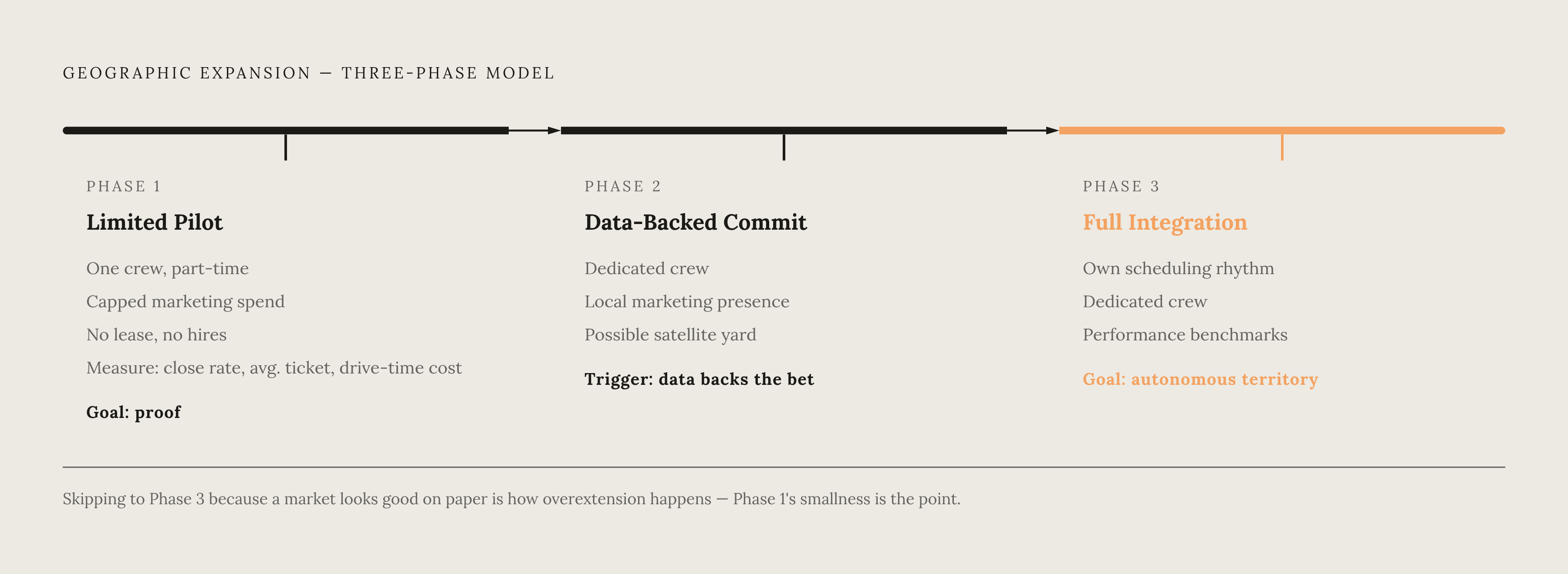
Phased entry isn't hesitation dressed up as strategy. It's a discipline that forces assumptions to get tested with real customers and real jobs before they turn into fixed costs the business is stuck carrying.
Phase one looks like a limited commitment: a single crew serving the new area part-time, marketing spend capped and closely tracked, no lease signed, no new hires beyond what's already needed to keep the existing territory running. The goal isn't profit yet, it's proof. Close rate, average ticket size, and drive-time cost all get measured against the assumptions built during the evaluation stage. If the numbers hold up, the second phase can lean on data instead of guesswork. If they don't, the exit costs stay small, because nothing permanent got built yet.
Phase two starts once the data backs the bet: dedicated crew, a real local marketing presence, maybe a satellite yard or storage setup if drive time actually justifies it. This is the stage where staffing pipelines and systems readiness, covered earlier, get tested under real, sustained load instead of a controlled pilot.
Phase three is full integration: the new territory runs with its own scheduling rhythm, its own crew, and its own performance benchmarks, fully folded into the business rather than treated as an experiment still running.
Skipping straight to phase three because the market looks good on paper is exactly how overextension happens. The signals covered here, saturation, lead drift, competitor pressure, demand shifts, staffing capacity, systems readiness, tell a contractor when to move. The phased model keeps that move from becoming overreach that drags the original, profitable territory down along with it.
Sources
- Home Service Industry Outlook 2026: What Operators Need to Know | LPP
- Home Services 2026 M&A Outlook - CFOx
- US Home Services Market Size, Share & Forecast 2035 | CAGR 7.20%
- Home Services Industry Statistics 2025-2026
- US Home Service Market Size & Share Outlook to 2031
- 2026 Home Service Trends Report | Jobber