Org Chart Design for a $3M to $7M Remodeling Company
Functional roles replace owner-dependent chaos when remodeling revenue hits $3M to $7M.

A $3M–$7M remodeling company needs an org chart built around functions. That shift decides whether growth brings better margins and more freedom for the owner or just more calls, delays, and decisions. The job is to define what each role must deliver, give it real authority, and build the structure in an affordable sequence.
Why the $3M–$7M band forces a structural choice, not just a staffing decision
Revenue is going up, but the owner’s day keeps getting worse. More jobs mean more questions, more interruptions, and more loose ends that only one person seems able to resolve. Hiring help has not stopped the calls. The business has more hands, yet its capacity still depends on the owner’s attention. That is a structural problem.
When responsibilities are built around particular people, a departure or promotion changes how the whole company works. Adding leads cannot fix that weakness. Once delivery hits its limit, taking on more work slows jobs and hurts margins, so the business grows at the cost of its health. Nor is there one fix for the entire band, because the company approaching $7M needs a different depth of leadership from the one just reaching $3M.
What a function-first org chart actually means for a remodeling company
A function-first chart starts with what the business needs delivered and then assigns someone to own it. A people-first chart starts with whoever is available. Two years later, the company has outgrown a job shaped around that person’s comfort zone. The owner then faces a difficult conversation with someone the business cannot afford to lose.
The practical correction is to define every role by two to four core deliverables. “Coordinates work” says little about success, while jobs finished within a defined schedule tolerance gives the role a clear outcome. When estimating, site supervision, client communication, and subcontractor coordination blur together, accountability becomes hard to locate and good performance becomes hard to repeat. Clear lanes and honest titles make responsibility visible before the company assigns a name to each box.
The five structural levels a remodeling company moves through, and where $3M–$7M sits
The five-level scaling map is useful for locating a bottleneck. For companies in this revenue band, the stretch that matters most runs from the Level 2–3 transition through Level 4. Most companies get stuck between Levels 2 and 3, where a real project manager with real accountability systems is the usual missing piece. Revenue alone does not identify the transition. Work that still cannot move without the owner is a better guide to the transition.
The $3M–$7M band straddles Levels 3 and 4. At Level 3, delivery no longer depends on the owner being the first person called to solve problems on every job site. Level 4 solves revenue dependence by removing the owner as the only source of new work. The order has consequences. A company that fixes delivery but never builds sales can plateau with excellent execution and no pipeline, while a company that builds sales first can sell work it cannot deliver.
The operations or production manager who removes the owner from daily delivery
For a company building this structure, the first priority is a dedicated operations or production manager. This person owns the production P&L day-to-day and makes the decisions that affect margins and schedules. The role requires a senior field manager compensation level because it demands judgment, accountability, and coordination.
Its four deliverables should be gross margin per job within target, jobs delivered within a defined schedule tolerance, subcontractor coordination without owner involvement, and field issue resolution below an agreed escalation threshold. Authority must match those outcomes. The manager reports to the owner, and the field reports through the manager. If the owner still answers routine delivery questions, the company has hired an expensive dispatcher. Once this role truly owns delivery, the owner can turn toward sales, relationships, and building the next layer beneath it.
The project manager layer and delivery without the owner on every job
Project managers own execution on individual jobs so that the operations manager does not become the next bottleneck. Cumberland Labs distinguishes that responsibility from the superintendent’s job. The project manager owns documentation, budgets, schedules, and client communication, while the superintendent manages field operations and daily on-site work. These are different functions, even when one person performs both. At $3M–$5M, a hybrid is common, but the chart should still show separate boxes.
Breakthrough Academy calls these arrangements “dual roles” and recommends marking them separately so the next hiring gap stays visible. For the PM seat, measurable deliverables include jobs within a defined gross profit margin target and client satisfaction scores above a defined threshold. Change orders must also be documented and approved before work proceeds, and subcontractor schedules coordinated without escalation to the operations manager. The PM reports to operations. With that seat clearly defined, lead carpenters have a real path to move up, with pay tied to deliverables and a title that comes with clear expectations.
The sales and estimating function and the separation of revenue from delivery
With delivery under control, the next constraint is the owner’s personal selling capacity. Highspire identifies dedicated sales or business development as the Level 4 move, with responsibility for the pipeline, estimating support, and client relationships. The 2026 Qualified Remodeler Top 500 lists getting leads and finding and hiring qualified employees among the biggest challenges remodelers face. A defined revenue function addresses the first while clearer roles support the second. The owner can remain involved in relationships without remaining the sole source of work.
Harrell Design + Build grew revenue by nearly 40% while the number of projects fell from 85 to 64. For a company in this band, that points toward better qualification as another growth lever alongside job count. Estimating also needs its own seat, even if part-time or shared, separate from sales and project management. When the same person estimates and manages a job, they have an incentive to conceal estimating gaps. Standardized templates with true-overhead markup give that separation a sound basis for margin accountability.
The office and administrative function and what breaks without ownership
Gaps in the back office often stay hidden because someone gets the work done in the end. A project manager chasing an invoice is not managing a job, and an operations manager absorbed in routine scheduling is not managing the production P&L. Meanwhile, the owner may be answering client calls that should have been handled two days earlier. Work getting done is not proof that it has a proper home.
Financial administration owns accounts receivable, accounts payable, job costing, and the invoice cycle, measured through days-to-invoice and cash position visibility. Scheduling and coordination owns crew, subcontractor, and client appointments, with no-gap scheduling and lead-time adherence as deliverables. Client communication owns status updates, change order documentation, and completion sign-offs, and its work is judged by satisfaction scores and documented approvals. One strong office manager may own all three with support at $3M–$5M. By $6M–$7M, they typically need separation or tools that remove manual overhead, without displacing the PM’s accountability for job-level results.
Reporting lines and accountability structures that make the chart work
Each week, the people who manage jobs report job status, margin-to-date, and open issues to the operations manager. Operations then reports the production summary and escalations to the owner, while the sales or business development lead reports pipeline, estimates out, and close rate. Monthly, the owner reviews the full P&L with job-to-job margin analysis to catch estimating drift before it becomes a pattern.
Each role should know what it can decide outright, what needs operations sign-off, and what warrants owner involvement. Requests that bypass reporting lines must be redirected to the responsible role. Otherwise, field staff can overturn the reporting line simply by calling the owner when they dislike a decision. At Level 3, the owner’s work becomes relationships, business development, and decisions no one else can make yet. Making that shift requires stopping work that the new roles now own, which is harder than merely hiring someone to do it.
How to sequence the hires when budget and timing constrain the ideal structure
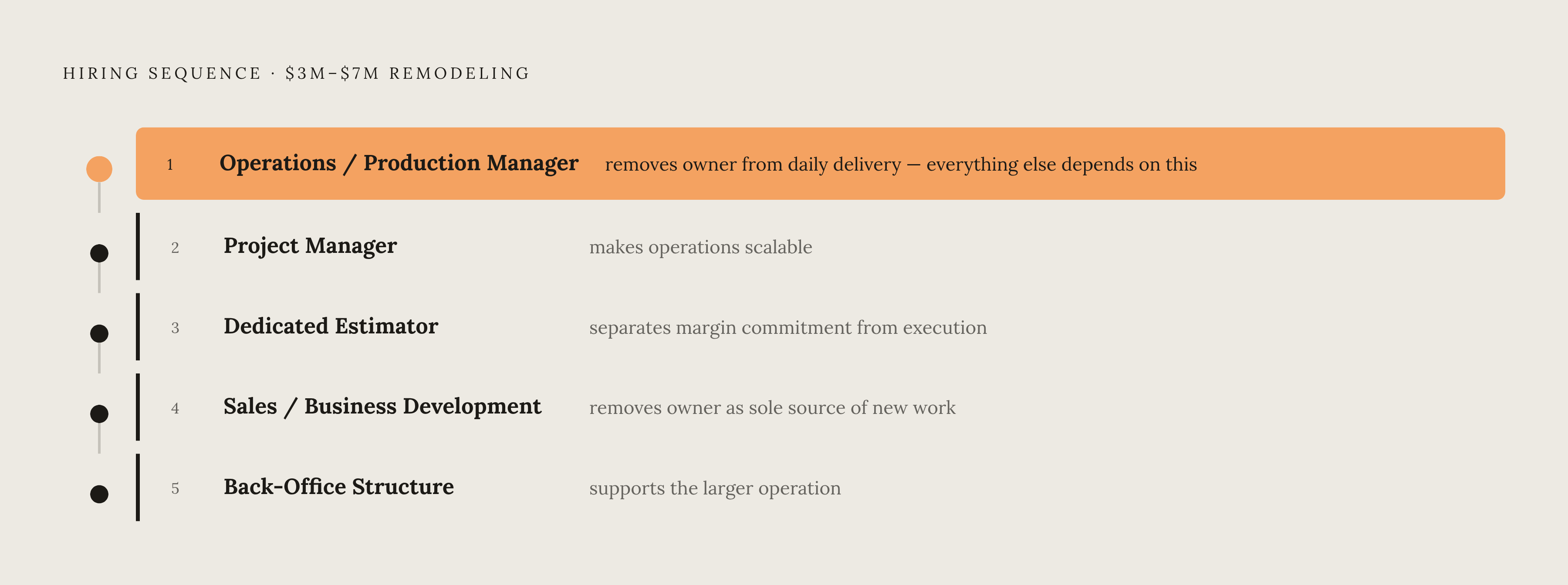
A company does not have to fund the finished chart all at once. The practical sequence starts with operations or production management to remove the owner from daily delivery, followed by project management to make that role scalable. A dedicated estimator comes next to separate the margin commitment from execution accountability. Sales or business development follows to remove dependence on the owner for new work, then the back-office structure expands to support the larger operation. That hiring sequence requires continued ownership of existing administrative work.
Dual roles make the transition financially possible, provided they remain temporary and visible. A capable person doing two jobs can make the unfilled seat look unnecessary right up until both functions lose their owner. To avoid that trap, the chart should describe the company 12 months from now. The academy recommends designing for the future to support thoughtful hiring and proactive operations planning. Spelling out the role before it needs to be filled also makes it clearer where onboarding should start and what the new hire will be expected to do.
Automation can help fund the sequence without replacing it. Highspire identifies AI and virtual assistants as ways to extend capacity before adding headcount for work that truly requires a person. Lead response, quote follow-up, scheduling reminders, and review requests are candidates for that support, as are document management and reporting. Accountability stays with the role that owns the result. Taking manual work off the office manager’s plate lets a smaller team do more while the company builds the leadership structure it still needs.
What the completed $3M–$7M org structure enables that a people-organized company cannot
With the full structure in place, the company can grow without every added piece of work having to go through the owner. It also makes margin improvement possible at the same revenue level, because estimating discipline, true-overhead markup, and job-to-job review each have an accountable owner. The recruiting benefit follows the same logic, because candidates can see what a role owns and where it can lead.
Owner freedom is the most immediate test of whether the structure works. Jobs, lead response, quote follow-up, and client communication can move without the owner’s direct involvement in each. That leaves time for the relationships and strategic decisions that cannot yet be delegated. The business approaching $7M then has functional leaders who can act independently. The first step is specific enough to do now. Define every existing role by its two to four deliverables, then identify which functional seat is missing or assigned to the wrong person.