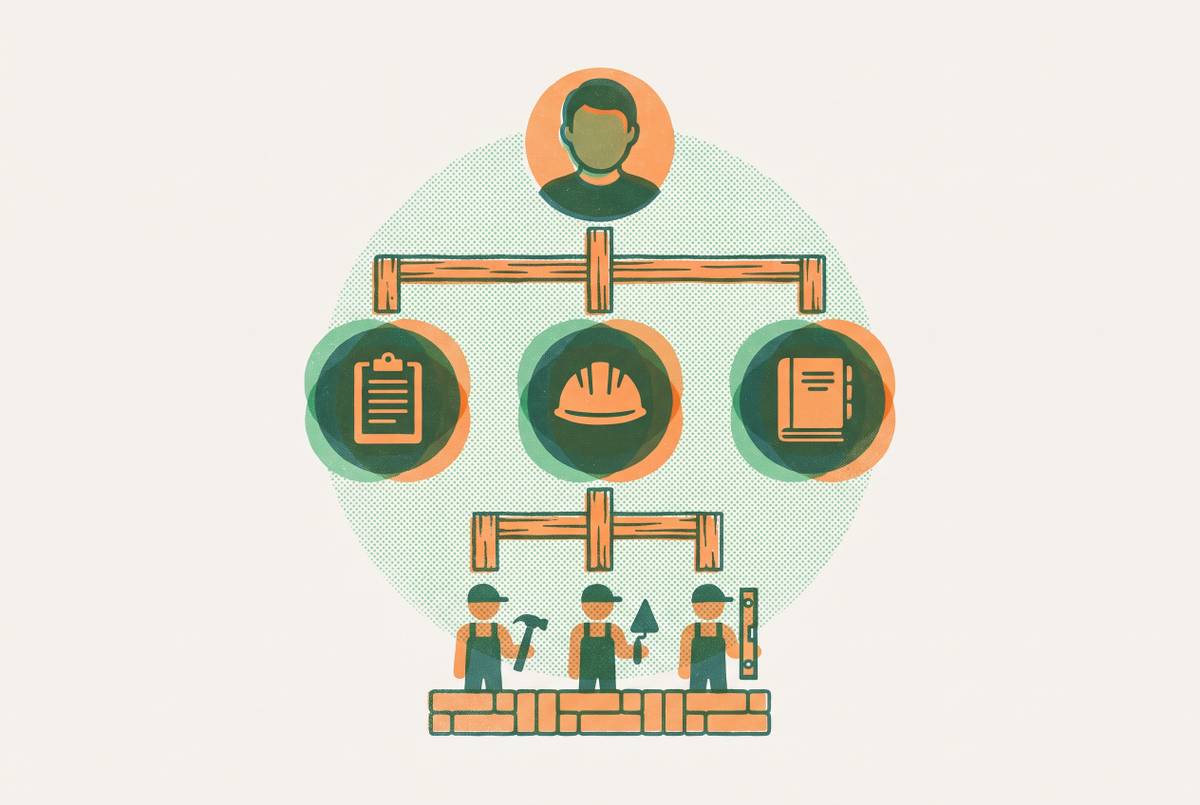
Performance-Based Compensation for Field Crews in Hardscaping
Profit-based bonuses tied to phase completion keep hardscape crews accountable.
Performance-based compensation for hardscaping field crews needs to reward installation work that earns a profit, with pay based on more than speed or extra sales. The right pay plan has a competitive base wage, project bonuses tied to profit, labor budgets for each phase, and firm rules for quality. Built that way, performance pay gives skilled installers a reason to stay and a financial stake in protecting the contractor’s margin.
Why hardscaping crews respond differently to incentives than maintenance crews
The contractor’s problem is simple to describe. Some crew members do maintenance and others build hardscape projects, so one set of performance measures does not feel fair to both. Maintenance crews do much the same tasks at many stops, while hardscape crews work through separate phases on jobs that call for different skills, material tolerances, and timelines.
A paver patio is not a retaining wall. Each hardscape contract has a fixed scope, a specific labor budget, and a margin that holds or erodes on-site. A flat hourly rate gives installers no financial stake in managing their hours against that estimate, even when their skill keeps a job profitable and prevents an overrun. Those skills are scarce and costly to replace, so the pay model has to address both project performance and retention.
The labor cost structure that makes getting this right financially urgent
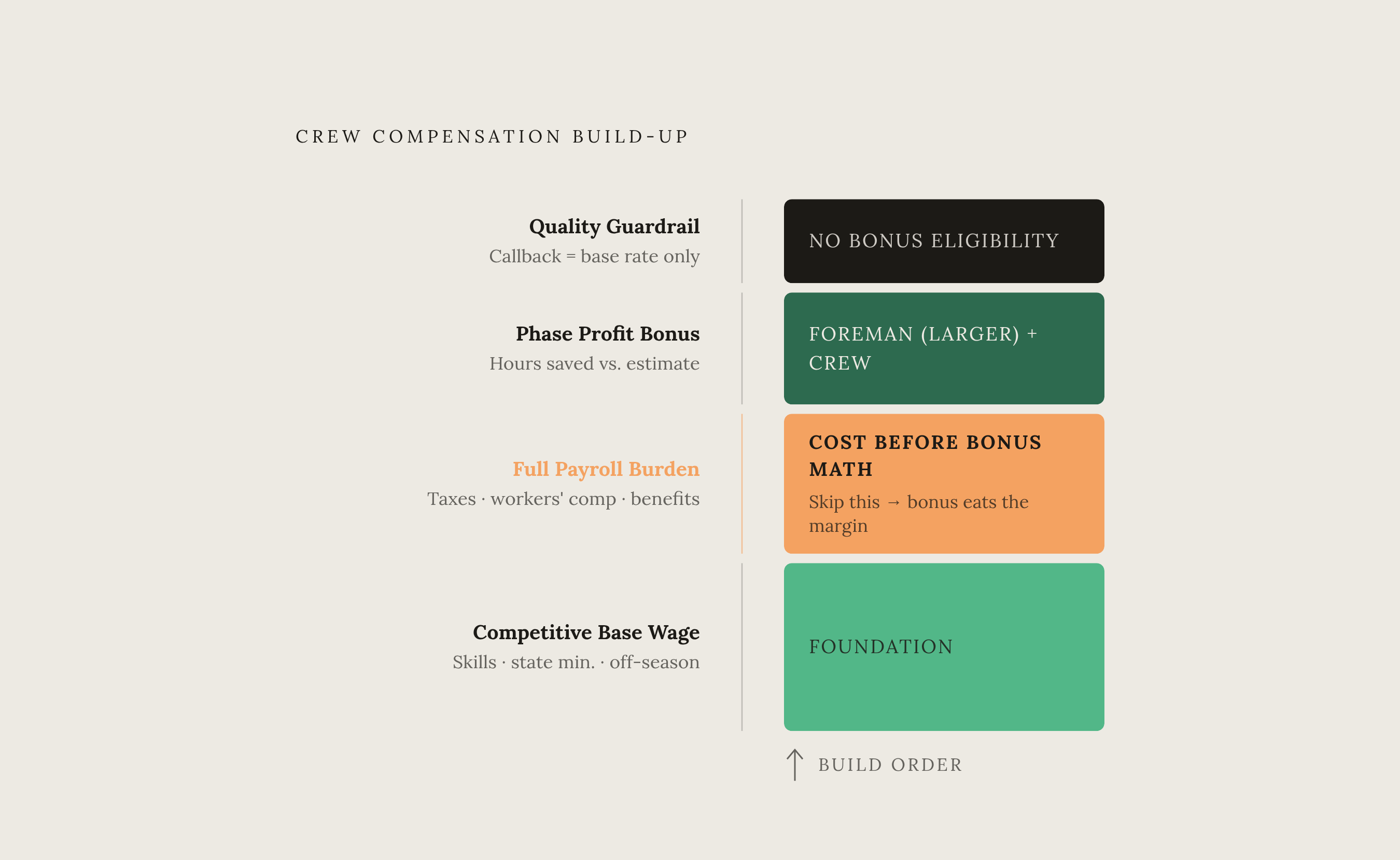
Labor is the largest cost line in a hardscape business, and the wage on a paycheck is only part of it. Payroll taxes, workers’ comp, equipment depreciation, vehicle costs, and general liability all widen the gap between take-home pay and the amount billed to the client. The base wage is only the starting point. Any incentive calculation that treats it as the full cost of labor overstates how much money is available to share.
Workers’ comp belongs in that calculation before a bonus split is set and the contractor promises a payout. The same applies to taxes and benefits. A bonus can seem affordable when only wages are counted, yet eat up the margin it was meant to help create.
Comparing hourly pay also leaves out the cost of turnover. Losing an installer mid-season disrupts schedules and puts quality at risk on unfinished work, while replacing a crew leader also means losing knowledge of client preferences, site conditions, and efficient technique. A higher flat rate may help compete for workers, but it raises fixed costs without changing what the crew earns for protecting a labor budget. A competitive base with additional pay tied to profitable performance lets the crew’s upside grow when the business earns more.
Why upsell commissions — the standard lawn care incentive — don't translate to hardscape project work
The 2026 hybrid model for landscaping maintenance combines a competitive base wage with commissions on add-on services that crews identify and perform during routine visits. That opportunity fits the work. A maintenance crew can spot a legitimate need while servicing a property, but a hardscape crew arrives to execute a scope already defined in a signed contract. Pushing for more sales during installation can lead to scope creep, trouble with clients, and a smaller margin.
Revenue-based commissions create a separate problem even when the scope stays fixed. A percentage of the contract value rewards the size of the sale without accounting for the labor needed to deliver it. The crew can earn its share while the contractor absorbs the overrun, because gross revenue does not reveal whether the job was profitable. A larger contract is not necessarily a better job.
For hardscape contractors, incentives should be tied to project profitability. That rewards installers for parts of the work they can control, such as keeping phases on schedule, keeping labor hours in check, and meeting quality standards.
The hybrid structure that actually fits hardscape project work
The structure starts with a competitive base wage. It must pay for the skills that hardscape installers bring to the job, meet state minimum wage requirements, and give workers a steady income during off-season or weather-delayed weeks. A project bonus should add earning potential without making skilled workers depend entirely on how a particular job unfolds.
The next component is a profit-linked bonus calculated on completed phases against the labor estimate. Clearly defined phases give the crew a schedule and hours budget to work toward, making the promise of extra pay more concrete than a hope that the whole job goes well. One longstanding trades model rewards a crew that finishes a job in less than the budgeted time, without cutting corners, by still paying for the budgeted time. The saved hours become the crew’s reward. For that approach to protect margin, the contractor must account for the full payroll burden before deciding how much of the gain to share.
A larger share for the foreman fits a crew where the foreman talks with clients, keeps the work coordinated, and takes more responsibility for the technical work. An even split fits a crew whose members share both the skilled work and the task of keeping it coordinated. Foreman and supervisor compensation should also account for overall budget, schedule, quality, and safety performance, so finishing quickly does not eclipse the rest of the job.
LawnPro’s pay-for-performance feature illustrates the payroll mechanics, rather than supplying a hardscape-specific formula by itself. Its six configurable models range from hourly only and hourly plus flat bonus to revenue-percentage, flat-per-job, and pure-commission arrangements. That range is not a recommendation to use them all. For the structure described here, hourly pay plus a bonus is the relevant starting point, with project profitability determining the reward.
The platform also shows how pay protection and cost comparison can work in practice. Before payroll runs, it flags pay periods where total pay divided by hours worked is below the state minimum wage threshold. Separately, it calculates hourly and performance-based earnings and pays whichever is higher. Its payroll view places jobs, hours, base pay, and performance earnings side by side, while its analytics compare actual performance pay with what straight hourly pay would have cost.
The metrics hardscape crews should actually be measured on
A hardscape bonus needs a short, job-specific set of measures. The core measures are when each phase ends compared with the original schedule, labor hours compared with each phase’s estimate, workmanship when each phase ends, and how well the site is kept in order and safety rules are followed. Hours show whether the crew controlled labor, while workmanship and safety prevent that control from becoming a reward for shortcuts.
These measures depend on a usable estimate. “Two days for the patio” does not give a crew or foreman enough detail to judge performance across the work. Phase-level labor budgets provide the benchmark for earning a bonus. For crews moving between maintenance and hardscaping, the measures must change with the work instead of forcing both crew types into one universal score.
The callback rule is the central quality guardrail. A crew paid for speed can look productive when the job ends yet leave defective work that requires costly rework weeks or months later. The pay agreement should therefore state upfront that callbacks and rework are paid at the base hourly rate only, with no bonus eligibility. Workers still get paid for that time, but correcting defective work creates no additional performance reward.
Phase checkpoints make the quality requirement practical on-site. Checking base compaction before laying pavers or inspecting drainage before capping a retaining wall can catch problems before they become expensive to correct. Each checkpoint also gives the foreman a defined moment to confirm workmanship before the phase earns bonus eligibility.
How pay transparency and visible career progression turn compensation into a retention tool
Aspire’s 2026 research identifies limited growth opportunities, lack of recognition for quality work and consistent performance, and inefficient operations as reasons workers leave. Those problems do not disappear with a raise. An installer can earn more per hour and still have no clear path forward, no recognition for careful work, and daily frustration over wasted time. A retention-focused pay system has to make good work visible and advancement understandable.
Contractors should document how and when workers can earn more through tenure milestones, skill development, or role advancement. Workers should not have to guess what qualifies them for the next pay level. A bonus formula that only the owner understands does little to help, because workers cannot see how the choices they make today affect their pay. Clear rules give them something they can plan around.
LawnPro’s employee dashboard shows completed jobs, hours worked, bonuses earned, and running totals, so employees do not have to wait until payday to see the result of their work. Its leaderboards also identify top earners and productive crew members, adding recognition without a separate financial reward. These tools make the pay system visible, but the underlying quality rules still define what good performance means.
ICPI certification for paver installation, NCMA credentials for wall systems, and equipment operator qualifications provide documented steps that can connect to specific wage bands or bonus tiers. Tying increases to skills rather than tenure alone gives workers a reason to pursue credentials and gives the contractor a return on training. The path from installer to specialist to foreman then becomes a pay pathway.
How a performance pay system produces margin advantage, not just crew satisfaction
The financial return comes from the relationship between added pay and added production. When crews do quality work in fewer labor hours than the estimate allows, the contractor can earn a better job margin while charging the client the same price. The incentive payout is a cost, but it comes from value the improved performance helped create. Across projects, productivity gains can outweigh the bonuses paid to earn them.
Skilled installers know what properties are like, how materials behave, and what clients want, which makes rework less likely on future jobs. Replacing them loses more than a pair of hands. Stable crews also give contractors a more dependable labor cost model, which supports more confident quoting and the ability to complete more projects per season.
That production capacity becomes especially important when demand is strong. For contractors using AI-powered quoting and lead management tools to keep the pipeline full, the constraint can shift from finding work to completing it. More leads do not create more installation hours. A pay system that improves output per project helps the same headcount complete more jobs, while quality guardrails keep that added volume from returning as unpaid margin in rework.
The advantage is making skilled workers’ financial interests match the contractor’s need for profitable, well-executed projects. Competitors can raise wages without changing how work gets done, but that alone does not connect payroll to production. A hardscape-specific performance pay model is an operational edge.