Financing Options for Homeowners and How Contractors Use Them to Close Jobs
Contractors close more jobs by offering financing upfront, not as a last resort.

Homeowner financing helps contractors close larger jobs by changing how they talk about the price. It works best not as a rescue offer after a homeowner hesitates, but as a standard part of quoting. For hardscaping contractors, it helps to show monthly payments early, find lenders that fit the homeowner, and make financing part of how they sell.
Why hardscaping contractors lose high-value jobs before price is ever the real issue
A large patio-and-retaining-wall quote can stop a conversation before the homeowner has weighed the value of the work. The total lands against the cash they have available. When they say “let me think about it,” they may be trying to solve a payment problem. The project has become a sudden claim on their savings. A monthly payment turns that collision into a budget question they can answer.
That distinction explains why offering financing only after an objection is the wrong sequence. By then, the cash total has anchored the homeowner’s thinking, and financing can sound like an admission that the price is too high. What should be a normal payment choice becomes a consolation prize. The fix is to introduce the payment option before the lump-sum price sets the terms of the discussion. The contractor does not need to lower the price to change how the homeowner considers it.
Who hardscaping's best financing customers actually are
Wisetack’s 2026 financing benchmark reports that the average approved customer has a 730 FICO and a solid household income. That profile fits dual-income households protecting liquidity. They want to preserve an emergency fund while making room for a project in the monthly budget. Presenting financing as a lifeline misses their reason for using it.
For hardscaping, that customer may be a practical backyard upgrader or a retired homeowner improving daily life. A mid-five-figure project including a patio, pergola, fire feature, and drainage is an elective purchase that competes with keeping cash in savings. A secure homeowner can prefer monthly payments for the same reason they finance a car. Credit-challenged buyers also need ways to pay, but they need different products. They should not define how the contractor presents financing to everyone else.
How contractor financing mechanics actually work and what it costs the contractor
In the direct-payment model, the contractor enrolls as a merchant or partner, usually free or at low cost, and presents financing through an app, tablet, or link. After completion verification, the lender pays the contractor directly, typically within one to three business days. The homeowner then repays the lender, which carries the repayment risk and handles collections. Regions Home Improvement Financing states that funds are typically deposited in the contractor’s account within 24 hours of a request.
The contractor’s main cost is the merchant fee, and that fee needs deliberate pricing. Standard-rate plans have lower fees than promotional plans with large subsidies. The useful comparison is whether the additional subsidy helps close enough valuable work to justify its cost. A promotional offer that wins a full outdoor living build can serve a different purpose from the same offer on a small job.
Save promotional financing for larger replacements or full outdoor living projects where it helps close the sale. For smaller tickets, a standard-rate plan around 9.99% APR may already offer a monthly payment that appeals to the homeowner without the larger subsidy. Pre-qualification takes two to five minutes and uses a soft credit pull that does not affect the homeowner’s credit score. Most platforms can send the link by text or email. That makes checking eligibility a step within the appointment rather than another problem the homeowner must solve afterward.
The lenders hardscaping and remodeling contractors should know about
Which lender fits depends first on how long the contractor has been in business, its average ticket, and whether it needs promotional financing. Service Finance Company is an option for newer businesses that have been in business for at least six months under the Lennox/SFC Consumer Finance Program. Sunlight Financial also fits early-stage consideration because it has no strict two-year minimum. Sunlight Financial requires contractors to have licensing, credentials, and proof that the business is operating.
For established contractors, the planning group includes GreenSky, Acorn Finance, LendKey, Momnt, and HFS Financial. The business-age summary places most of these at two years, but that is not a universal enrollment rule. LendKey has a two-year requirement. Acorn Finance’s own onboarding information says contractors must be licensed and in good standing and have their business credentials checked, but it lists no minimum for years in business. Regions Home Improvement Financing requires more time in business: 5+ years in business, or 3+ years for existing Regions clients.
The payment model matters as much as entry requirements. Acorn Finance uses a marketplace model, while Momnt describes its platform as helping merchants offer financing at the point of sale. HFS Financial funds the homeowner directly, so its contractor program is a referral or partner arrangement. The homeowner controls when and how the contractor gets paid. That distinction matters when matching a program to the shop’s payment process.
Product labels also need care. Synchrony HOME Credit Card is a consumer retail card issued and serviced by Synchrony Bank. The useful match depends on access, payment flow, job size, and approval coverage. Running two lenders, one for prime approvals and another for broader approval rates, is a documented best practice for maximizing funded jobs.
Government-backed and alternative financing options that expand the addressable job pool
A standard lender’s decline does not exhaust the homeowner’s options. FHA Title I home improvement loans are government-backed and can serve homeowners with limited equity or those unable to qualify for traditional home equity financing, with no income limits. PACE financing instead attaches repayment to the property tax bill and bases approval on home equity and mortgage payment history, without a traditional credit score check. It can be relevant for eligible energy-efficient or permeable hardscaping in PACE-eligible states. Its title process adds steps, which may be worth the friction on a large project.
Home equity loans and HELOCs give homeowners who have substantial equity another way to pay for a full outdoor living transformation. Same-as-cash loans help homeowners keep money on hand while they wait for a bonus, tax refund, or insurance payout. Regions Home Improvement Financing describes these as short-term loans that waive interest if the full balance is paid within the promotional period. Rent-to-own programs serve buyers below standard lender minimums without a traditional credit check or contractor-held receivables. The contractor’s job is to know these routes exist and mention a suitable alternative. Having an answer after a decline can keep an otherwise lost job alive.
Where financing enters the sales conversation and why sequence determines the outcome
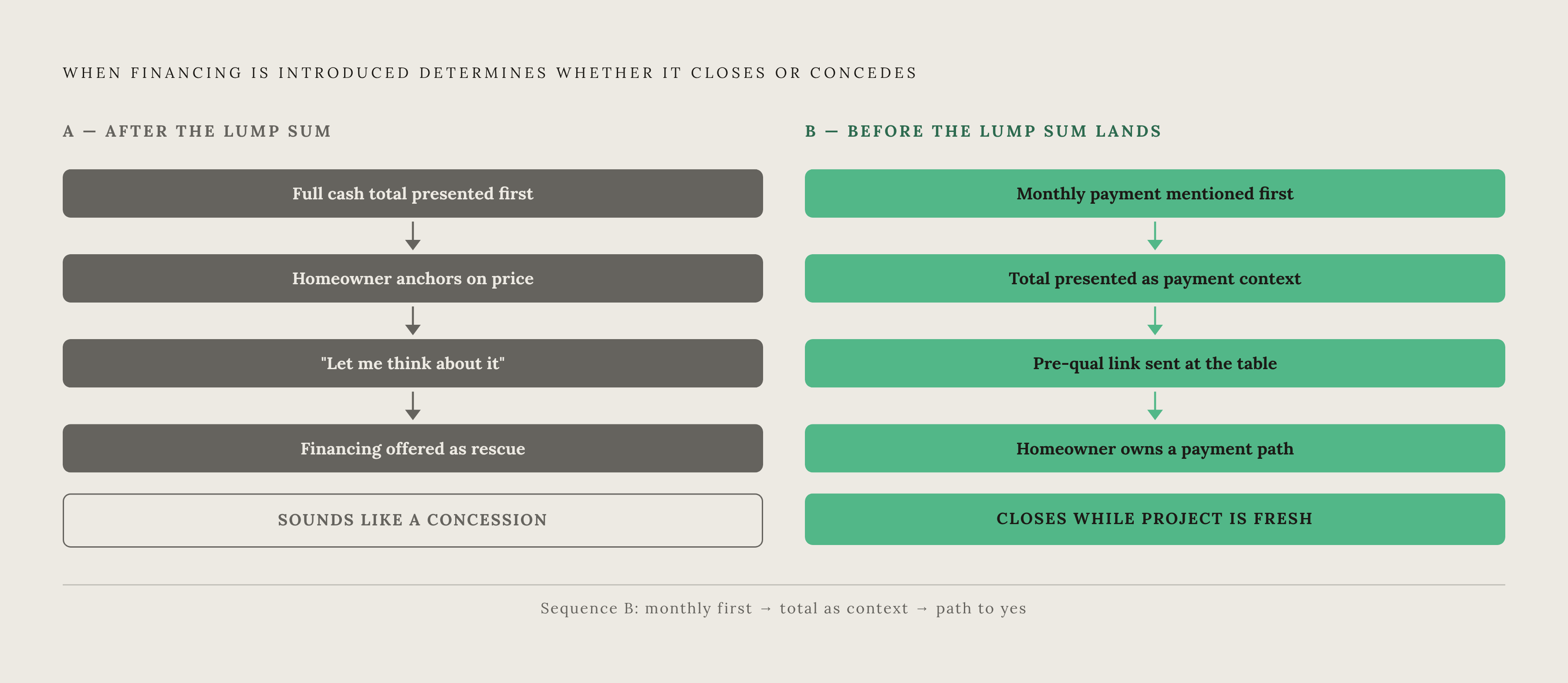
Start by establishing that monthly payment options are available, rather than waiting to decide whether this particular homeowner appears to need them. Then put the monthly number into the discussion before the full cash total becomes the anchor. Present the total as context for the payment choice. This keeps the offer from depending on whether the homeowner visibly flinches.
Make pre-qualification part of that sequence. Send the link before the appointment or present it as a short eligibility step at the kitchen table. The homeowner can use a phone to check options instead of leaving the meeting with a vague plan to arrange financing later. Pre-qualification moves the conversation toward an available payment path.
For projects with a utility or energy dimension, tie the payment discussion to the problem the work addresses. Outdoor lighting, drainage, and permeable paving can support comparisons with electric bills, water bills, or recurring landscaping repairs where those comparisons apply. When incentives apply, show gross and net prices separately so the homeowner understands the effect of tax credits, rebates, or utility programs before considering the monthly payment.
What embedding financing in the quoting tool actually changes about close rate and job size
A sales sequence is only useful if reps follow it consistently. Putting the monthly payment in the proposal tool, beside the lump-sum total, removes the need for each rep to remember or decide when to bring it up. Financing becomes part of what every homeowner sees. That matters because a lender relationship alone does not change a quote. The tool turns access to financing into a standard presentation.
The same approach changes how homeowners compare material tiers. A premium patio package can look like a large jump in cash price but a smaller difference in the monthly budget. Contractors who provide financing experience a 30% increase in job sizes. The payment comparison gives the homeowner a way to consider the upgrade without treating the whole price difference as an immediate withdrawal from savings.
Pre-qualification before the appointment supports that comparison. A homeowner who has already checked eligibility arrives with a clearer sense of the payment options. The conversation can then focus on confirming the fit. Together, the link and the proposal display make the process less dependent on an individual rep’s comfort with the subject.
The approval rate problem that silently drains revenue even when the program is running
A functioning financing program can still lose closeable jobs if too many applications stop at a decline. That is why approval rate belongs in the contractor’s revenue picture. The homeowner may want the project and accept the price, yet have no usable payment route through that program. In that case, better price presentation has reached its limit. The next obstacle is underwriting coverage.
A second lender with different underwriting criteria gives homeowners who were declined another way to seek financing. The purpose is not to duplicate the first program, but to cover homeowners it does not serve. If both standard lenders decline, PACE, subprime programs, and rent-to-own may give the homeowner other ways to pay where they fit. These options still leave some applicants unable to qualify. Contractors cannot control an individual credit decision, but they can control how much of their market the lender mix can serve.
Building financing into the business as a growth system, not a sales add-on
The business case becomes stronger when financing connects quoting, rep training, and follow-up. A higher close rate on the same lead volume creates more revenue without more marketing spend. A higher average ticket on the jobs that close brings in more revenue per truck per day. Those gains work together when the offer appears on every quote.
Follow-up belongs in that process too. A homeowner who did not ask about financing during the appointment can still receive a pre-qualification link by text shortly afterward. That gives the homeowner a way to pay while the project is fresh, before a call days later. Training should teach reps to follow the same steps as the quoting tool, and homeowners who are declined should have another route where one fits.
The growth advantage comes from removing avoidable payment friction while the homeowner is ready to buy. When that happens consistently, more of the existing lead flow can become funded work, and more buyers can choose the project they actually want.